
The Great Trade Recalibration
“There are no winners in a trade war. Going against the world will only lead to self-isolation.” — Xi Jinping, April 2025
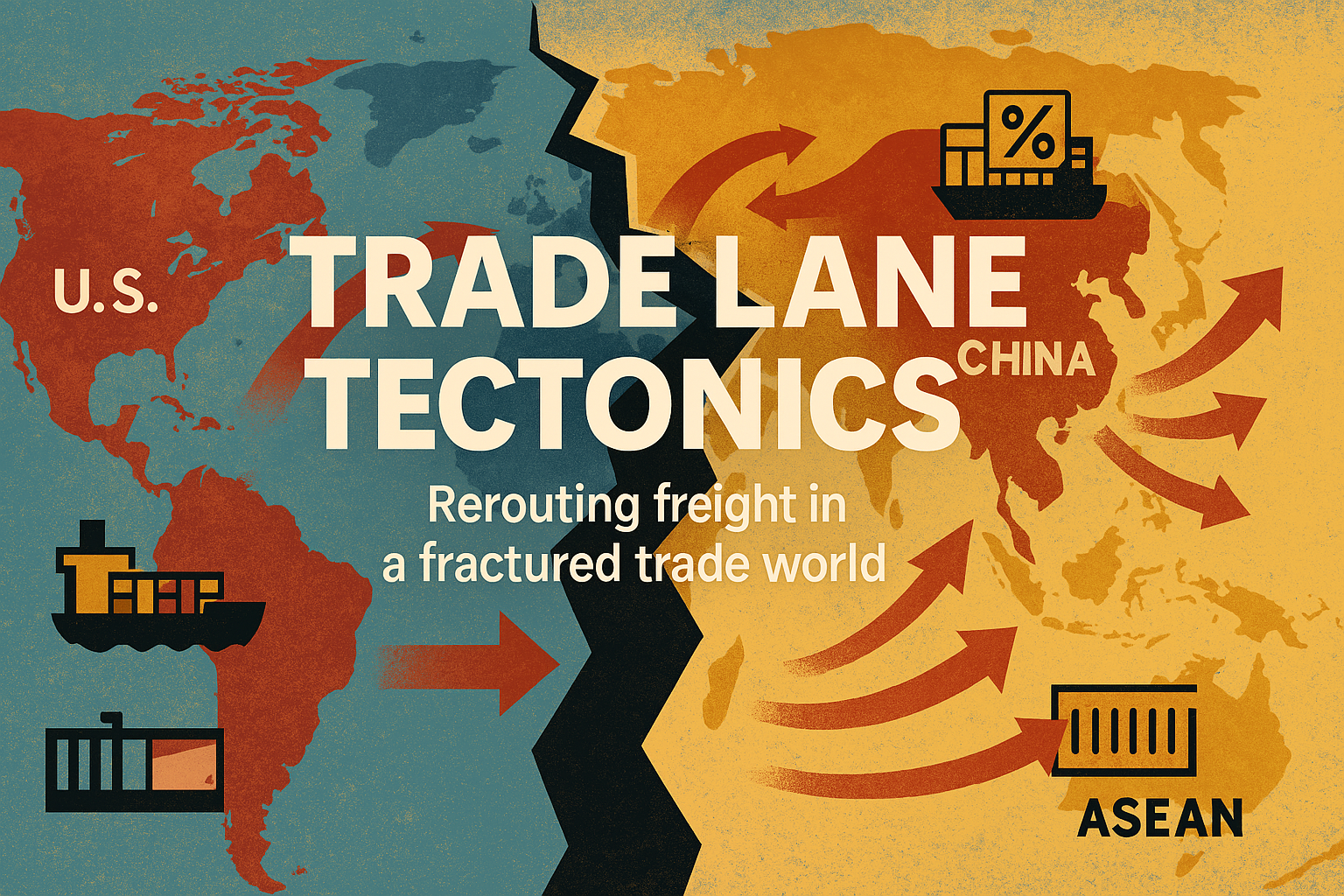
The US-China trade war has entered a new, volatile phase. With tariffs on Chinese goods now surging to a staggering 145%, the cost of doing business between the world’s two largest economies has become unsustainable. For many Chinese manufacturers, the US market has effectively closed. In response, Beijing is accelerating a pivot—away from America and toward Asia.
This realignment isn’t just a geopolitical chess move. It’s a logistics and supply chain story with global consequences. Southeast Asia is fast becoming the new hub for Chinese trade—and companies involved in cross-border logistics, freight forwarding, and customs compliance need to prepare for a shift in trade lanes, trade rules, and risks.
I. The End of a Lucrative Trade Lane
Once the crown jewel of China’s export strategy, the American market has become a high-tariff minefield. President Trump’s most recent tariff blitz—announced on April 2 and ramped up days later—pushed duties on Chinese imports to historic highs. These include:
- +100% base tariff on Chinese goods across the board
- +20% punitive tariff linked to fentanyl enforcement failures
- +25% escalation clause, triggered by China’s retaliation
That brings total duties on Chinese goods to 145%, making them virtually unsellable in the US.
China’s Ministry of Commerce responded by raising tariffs on US goods to 125% but issued a rare statement announcing it would not match any further hikes, describing Washington’s moves as economically absurd and politically unserious. With tariffs beyond market reality, a new chapter of de facto decoupling has begun.
📉 In 2024, China exported nearly $440 billion to the US. By early Q2 2025, that number is projected to drop by more than 50%, according to Capital Economics. (source)
This breakdown in trade has ripple effects far beyond the US and China. Supply chains built over decades are being reshuffled in a matter of months—and Southeast Asia is now squarely in the spotlight.
II. China’s ASEAN Pivot: Data and Diplomacy
Faced with dwindling access to the US market, China is rapidly strengthening ties with its neighbors—particularly in the ASEAN bloc. President Xi Jinping’s April 2025 diplomatic tour of Vietnam, Malaysia, and Cambodia was more than symbolic. It was a strategic signal that China intends to deepen regional integration, shift trade flows, and secure new export lanes.
In 2023, total trade volume between China and ASEAN nations reached $872 billion, according to Chinese government data. With US demand undercut by tariffs, this figure is poised to grow significantly in 2025 as China repositions ASEAN as its next export frontier.
Beijing’s strategy blends soft power, economic incentives, and infrastructure diplomacy. During Xi’s visits, several high-profile projects were highlighted:
- Ream Naval Base (Cambodia) – A Chinese-funded expansion near key maritime routes, raising eyebrows in Washington.
- Funan Techo Canal (Cambodia) – Designed to bypass Vietnamese ports and increase Chinese-Cambodian trade autonomy.
- Joint logistics and training hubs – Signaling long-term trade and military alignment in the region.
But this pivot isn’t just about diplomacy. ASEAN countries are also strategically positioned to absorb redirected Chinese exports—particularly low-value goods now blocked from the US. This will strain regional supply chains and heighten transshipment scrutiny, but for now, ASEAN represents Beijing’s best opportunity to keep its factories running.
“We depend both on China as an import market and on the US as an export market. We don’t want to displease either.”– Dr Nguyen Khac Giang, ISEAS-Yusof Ishak Institute
ASEAN’s balancing act is delicate. But with trade surging and infrastructure deepening, the region may soon shift from a secondary option to a primary node in China’s new export strategy.
III. Trade Redirection and Transshipment Tensions
As China redirects exports away from the US, many goods are now flowing through Southeast Asian trade hubs—not just for market access, but also as potential transshipment routes. The goal: avoid punitive tariffs by masking the true origin of goods.
This trend is putting countries like Vietnam and Malaysia under intense scrutiny from US trade enforcement agencies. Both have seen a spike in exports to the US that closely mirrors pre-tariff Chinese shipments—triggering accusations of indirect trade circumvention.
To mitigate risks, these governments are scrambling to bolster customs enforcement and origin verification protocols. Vietnam, in particular, has pledged to crack down on “label switching” and unauthorized reprocessing of Chinese goods for US-bound exports.
“We might come out of the negotiation with lower tariffs, but the trust between the US and Vietnam has already been damaged.”– Dr Nguyen Khac Giang, ISEAS-Yusof Ishak Institute
The US isn’t taking chances either. Under the Trump administration’s new compliance rules, freight forwarders and shippers can be held liable for routing decisions that appear to enable circumvention—even unintentionally.
For logistics players, this marks a shift from traditional risk assessment to real-time origin tracking, data audits, and proactive documentation. Third-party logistics (3PL) firms operating in the region are increasingly investing in:
- End-to-end supply chain traceability platforms
- Automated customs classification systems
- Collaborative compliance partnerships with ASEAN authorities
In short, what once may have been seen as a workaround is now a liability. Supply chain visibility has become a strategic necessity, especially for companies operating in transshipment-prone regions.
IV. The Overcapacity Challenge
Even as China builds new bridges across Asia, it faces a formidable internal problem: overcapacity. Factories that once ran at full tilt to serve American demand are now sitting on unsold inventory, particularly in low-margin industries like apparel, electronics, steel, and consumer goods.
With the US market largely inaccessible, and domestic consumption not yet strong enough to absorb the surplus, many Chinese exporters are looking to unload excess goods in Southeast Asia and Europe—often at cut-rate prices. This has sparked growing concerns about dumping and unfair competition in these regions.
Economists warn of an “initial burst” of redirected Chinese goods entering ASEAN and EU markets, flooding local supply chains with underpriced inventory. While this might reduce short-term costs for importers, it poses longer-term risks to:
- Local manufacturers unable to compete on price
- Regional trade balance and industrial policy stability
- Trust in fair trade practices
“The simple fact is, China operates on such a scale that if allowed, it can practically produce for the entire world.”– Dali Yang, University of Chicago
In Europe, this pressure is already prompting calls for anti-dumping measures, particularly in sectors like electric vehicles (EVs), solar panels, and industrial materials. The EU has even activated an import surveillance task force to monitor sudden surges in Chinese imports.
For ASEAN nations, the dilemma is more nuanced. While they benefit from increased trade volume and Chinese investment, their domestic industries are vulnerable to being outcompeted by state-subsidized Chinese manufacturers.
For global shippers and supply chain managers, the key takeaway is clear: overcapacity doesn’t just affect price—it affects predictability. Managing volatility in demand, customs enforcement, and local resistance will be essential to maintaining stable logistics operations.
V. Strategic Outlook: What Global Shippers Should Watch
The reshaping of China’s export strategy is far from temporary—it’s part of a broader realignment that’s redrawing the logistics map. For shippers, freight forwarders, and global trade professionals, the challenge is staying ahead of an increasingly complex and fast-moving environment.
Here are four key trends to monitor in the months ahead:
- Accelerated Trade Diversion: Expect more Chinese exports to be redirected through ASEAN and Latin America. Mexico may also rise as a “nearshoring” base for both Chinese and US firms looking to sidestep direct tariffs.
- Customs Enforcement Surge: US and EU authorities are stepping up transshipment investigations. Shippers will need to double down on origin documentation and compliance transparency.
- Infrastructure Investment Boom: China’s infrastructure push in Southeast Asia (ports, canals, railways) will shape long-term trade corridors. Countries aligning with Beijing may see early benefits but face geopolitical friction.
- Industry Rebalancing: Global overcapacity could lead to sectoral shifts in manufacturing. Shippers may find rising opportunities in specialty goods and value-added trade, while low-margin commodity flows become riskier.
Ultimately, the trade landscape is becoming less linear and more regionalized. Shippers will need to build greater agility into their operations, including route diversification, risk scoring, and adaptive compliance protocols.
In this evolving environment, logistics players that can deliver flexibility, visibility, and regulatory intelligence will be the ones who lead—not just react.

Why overpay for visibility? TRADLINX saves you 40% with transparent per–Master B/L pricing. Get 99% accuracy, 12 updates daily, and 80% ETA accuracy improvements, trusted by 83,000+ logistics teams and global leaders like Samsung and LG Chem.


Prefer email? Contact us directly at min.so@tradlinx.com (Americas) or henry.jo@tradlinx.com (EMEA/Asia)


![[TRADLINX Report] 2026 Shipping Market Outlook: Falling Rates, Rising Risks](https://blogs.tradlinx.com/wp-content/uploads/2025/11/2026-shipping-market-outlook.png)
Leave a Reply