
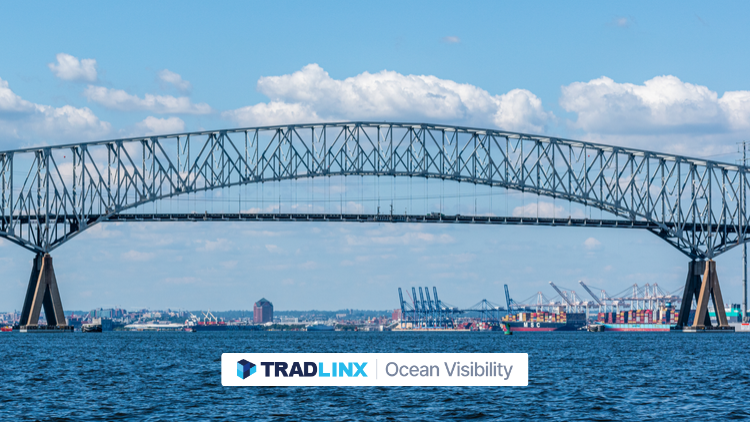
It’s been a month since the Francis Scott Key Bridge near the Port of Baltimore fell, bringing operations to a halt and redirecting shipping routes.
Ongoing Recovery at the Port of Baltimore
The port has been partly functional since the end of last month when a 35-foot deep temporary channel was opened to allow some vessels through. Plans are in place to deepen this to 45 feet by mid-May and to fully reopen the main channel by the end of May.
Wider Impacts: Increase Dwell Time
The collapse caused immediate rerouting of shipments. New York absorbed about 40% of the redirected cargo, Norfolk took 30%, and Newark-Elizabeth took 10%. This led to increased wait times for unloading containers: New York saw wait times increase by nearly 50%, from 2.75 to 4.1 days. Norfolk’s wait times grew to around 5 days, up from 2.7.

Persistent Threats to Supply Chains: The Cost of Uncertainty
The bridge collapse is part of a broader pattern of events that disrupt supply chains, from natural occurrences like the Panama Canal drought to geopolitical actions like the Houthi rebel attacks in the Red Sea.
Delays and Disruptions: Disruptions force shipments to take longer, less efficient routes, delaying delivery times and complicating logistics.
Local Supply Chain Breakdowns: Local shortages and production delays can arise when supply chains break down, affecting everything from stock levels to consumer services.
Economic Downturns: Companies facing disruptions often incur high reconstruction costs, which can strain finances further and slow economic activity in the affected areas.
Loss of Trust: Uncertainty reduces supply chain reliability and predictability, compelling companies to spend more on contingency planning.

The Importance of Digital Supply Chain Management
Integrating digital supply chain management (SCM) solutions, such as those from TRADLINX Ocean Visibility, is essential for managing these uncertainties.
Continuous Monitoring: Digital SCM tools track supply chain activities in real-time, enabling companies to respond quickly and effectively to disruptions.
Swift, Flexible Solutions: Using AI and real-time data, digital SCM systems can quickly adapt to changes, minimizing disruption times.
Streamlined Operations: Automation in SCM increases operational efficiency by reducing manual tasks and optimizing processes.
Informed Decision-Making: Digital SCM systems analyze data from various sources to inform decisions, helping companies anticipate and prepare for potential disruptions.
Suggested Topic for Future Articles: Exploring the Impact of AI on Supply Chain Resilience
This article would investigate how artificial intelligence can be integrated into SCM systems to not only streamline processes but also provide vital insights that improve the ability to withstand disruptions.
TRADLINX Ocean Visibility revolutionizes supply chain operations with its Ocean Visibility features, offering real-time shipment tracking, predictive analytics for lead times, and seamless management tools for freight forwarders and shippers worldwide.





Leave a Reply