
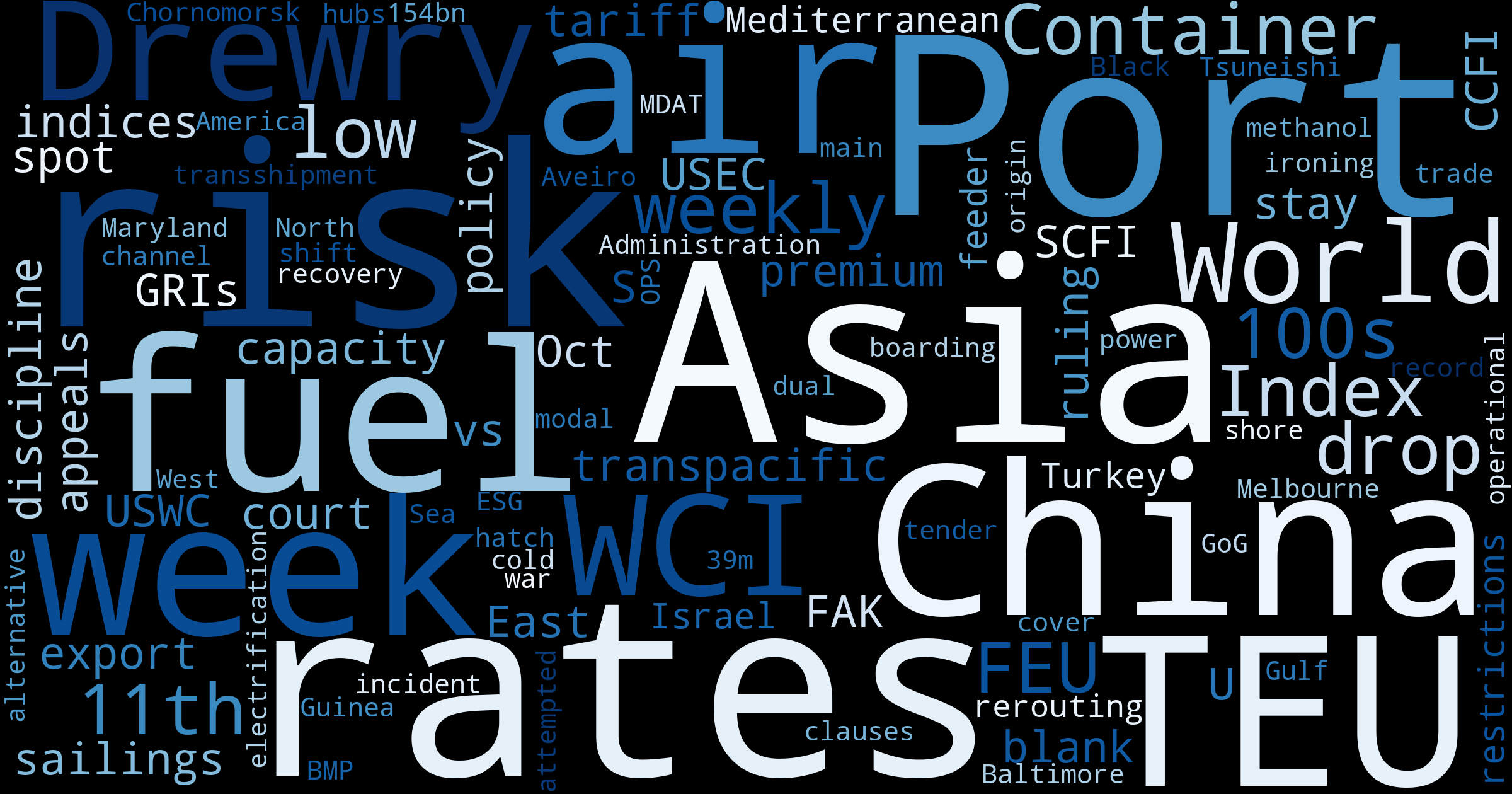
🧭 TL;DR (WEEK OF Aug 25–Sep 1, 2025)
- Rates mark an 11th straight weekly drop: Global container spot benchmark fell ~6% week-on-week to the low-$2,100s/FEU; transpacific lanes eased again as carriers use selective blankings to defend floors.
- Policy watch: A U.S. appeals court ruled most global “reciprocal” tariffs illegal, but kept them in place until mid-October pending appeal—importers should scenario-plan entries and contracts.
- Network constraints: Turkey formally barred Israeli ships and restricted Turkish calls to Israel, tightening East Med routing options; a minor Black Sea blast damaged a bulker near Odesa.
- Ops & ESG: Baltimore’s main channel reopened after recovery of a 30-ton hatch cover from a bulker blast; Aveiro launched a €1.4m shore-power tender; Australia’s Port of Melbourne posted record FY25 trade value and TEU.
📊 Maritime Mood Index
Score: 4.0 / 10 — Prices softer, policy louder, ops mixed
- Security Risk (→/↑): Minor blast on a bulker off Odesa; attempted boarding off Togo foiled by patrol craft; overall risk steady to slightly elevated.
- Rate Dynamics (↓): Global composite down ~6% week-on-week and now lower for 11 consecutive weeks; TP lanes continue to soften.
- Operational Disruptions (→): Baltimore’s channel reopened after hatch recovery; localized weather and safety controls but no major port closures this week.
- Policy Pressure (↑): Court ruling injects tariff uncertainty; Turkey–Israel restrictions complicate East Med routings.
- Innovation Momentum (→): Shore power projects advancing; alternative-fuel fleet milestones continue (methanol DF newbuild).
Interpretation: Markets extended their late-summer slide while policy risk re-centered the conversation. Expect carriers to defend rate floors via blankings; planners should check East Med routings, war-risk clauses, and watch tariff timelines while locking week-specific ocean and air quotes.
🚨 Top Headlines to Watch (Aug 25–Sep 1)
| Theme | Key Development | Operational Relevance |
|---|---|---|
| Container Spot Rates | Global benchmark fell ~6% WoW to the low-$2,100s/FEU (11th straight weekly drop). | Re-price spot; anticipate month-start blankings/GRIs; monitor premium vs. FAK spreads for late bookings. |
| Tariffs (U.S.) | Appeals court ruled most global tariffs illegal, but kept them in force until mid-Oct pending appeal. | Run “if/then” playbooks on HTS exposure, refunds/claims language, and vendor terms; avoid over-committing net-of-duty pricing. |
| East Med Access | Turkey barred Israeli ships from its ports and restricted Turkish calls to Israel. | Expect feeder re-routing via alternate hubs; confirm transshipment legs and cutoffs for Levant cargo. |
| Security – Black Sea | Belize-flag bulker sustained minor damage near Chornomorsk after contacting an unknown device. | Keep war-risk clauses current; check P&I guidance; add buffer for Black Sea calls. |
| U.S. East Coast – Baltimore | Main channel reopened after recovery of a 30-ton hatch cover from a bulker blast. | Normal traffic resumed; verify any residual pilotage/convoy notes on the day of call. |
| ESG – Shore Power (Aveiro) | €1.4m OPS tender launched to electrify berths. | Future reductions in at-berth emissions; track grid capacity and OPS compatibility by vessel class. |
| Oceania – Port of Melbourne | Record FY25: ~A$154bn trade value; ~3.39m TEU. | Solid Oceania demand backdrop; review capacity and rotation choices on AU services. |
📊 Market Movements
Container Rates: 11th Weekly Decline, Floors in Sight
Global spot pricing fell again last week, with the composite index sliding to roughly $2,120 per 40ft. Transpacific benchmarks (Asia→US West/East Coast) edged lower, and carriers signaled additional ad-hoc blankings into early September to steady yields.
- Global Composite: ~−6% week-on-week to the low-$2,100s/FEU; down for 11 straight weeks.
- Asia→US Lanes: Both USWC and USEC spot levels softened; spreads remain sensitive to last-minute premium space.
- Driver: Easing demand post early-summer spike; capacity discipline via blank sailings.
Air Cargo: Mixed Signals, Asia-Origin Firmness
Asia-origin air rates stayed relatively firm into North America on tighter capacity management, while some Europe lanes softened. Use lane-level quotes to validate any rapid modal shifts from ocean.
Regional Port Conditions
| Port / Corridor | Trend | Driver | Takeaway |
|---|---|---|---|
| Baltimore (US East) | Channel reopened | Hatch cover recovery completed; safety zone lifted | Normal traffic; verify day-of pilotage/convoy advisories |
| East Mediterranean | Routing adjustments | Turkey–Israel port restrictions | Confirm feeder connections and transshipment hub selection |
| Aveiro (Portugal) | Shore power build-out | OPS tender (≈€1.4m) launched | Plan OPS-ready calls; check vessel compatibility timelines |
| Melbourne (Australia) | Record FY25 backdrop | High trade value and TEU throughput | Review rotation/capacity on AU services for Q4 |
⚠️ Operational Disruptions
Black Sea (Chornomorsk/Odesa)
A Belize-flagged bulk carrier suffered minor damage after contacting an unknown explosive device near Chornomorsk. There were no casualties reported; inspections and risk assessments are ongoing.
- Status: Minor hull damage; traffic largely unaffected beyond local checks.
- Driver: Residual war-risk and unexploded ordnance in coastal approaches.
- Action: Keep war-risk clauses current; add buffer to Black Sea calls; confirm insurance guidance.
Gulf of Guinea (Off Lomé, Togo)
An attempted boarding on a small tanker south of Lomé was disrupted by a patrol craft; crew reported safe and vessel proceeded under escort. Incidents remain infrequent but non-zero.
- Status: Attempt foiled; vessel and crew safe.
- Driver: Opportunistic small-boat boardings in mid-shelf waters.
- Action: Maintain BMP-West posture; coordinate with MDAT-GoG for transits.
🛠 Innovation & Infrastructure
Shore Power & Alternative Fuels: Concrete Steps
Portugal’s Aveiro opened a tender to deploy on-shore power at berth, while Tsuneishi launched a 5,900 TEU methanol dual-fuel container ship—its largest container build to date—underscoring the steady march toward lower-emissions operations.
- Relevance: OPS can cut at-berth emissions and noise; methanol dual-fuel expands routing flexibility under tightening ESG requirements.
- Action: Track OPS availability by port; validate fuel-capable tonnage on your main strings.
Turn this week’s rate slide, policy shifts, and routing changes into reliable ETAs—track vessels, ports, and exceptions in real time with TRADLINX Ocean Visibility.

📚 Sources & Reference Links
- Drewry World Container Index – Aug 28, 2025 update – Aug 28, 2025
- Reuters – U.S. appeals court: most Trump tariffs illegal; stay until Oct 14 – Aug 29, 2025
- Reuters – Turkey bars Israeli ships; restricts airspace – Aug 29, 2025
- Reuters – Belize-flag bulker damaged near Odesa – Aug 31, 2025
- Maritime Executive – USCG lifts hatch; Baltimore channel reopened – Aug 29, 2025
- Maryland Port Administration – Channel reopened notice – Aug 28, 2025
- WorldCargoNews – Port of Melbourne posts record FY25 volumes – Aug 30, 2025
- PortsEurope – Aveiro launches OPS tender – Aug 26, 2025
- Offshore Energy – Tsuneishi methanol DF boxship – Aug 28, 2025
- Maritime Executive – Attempted tanker boarding off Togo foiled – Aug 29, 2025
- MDAT-GoG – Warning 008/2025 (suspicious activity south of Lomé) – Aug 29, 2025
- Financial Times – Owners shift away from Chinese sale-leaseback finance ahead of U.S. port fees – Sep 1, 2025
Why overpay for visibility? Tradlinx saves you 40% with transparent per–Master B/L pricing. Get 99% accuracy, 12 updates daily, and 80% ETA accuracy improvements, trusted by 83,000+ logistics teams and global leaders like Samsung and LG Chem.


Prefer email? Contact us directly at min.so@tradlinx.com (Americas), sondre.lyndon@tradlinx.com (Europe) or henry.jo@tradlinx.com (EMEA/Asia)




Leave a Reply