
How Will Global Supply Chains Change After July 9, 2025? A Corporate Strategy Roadmap
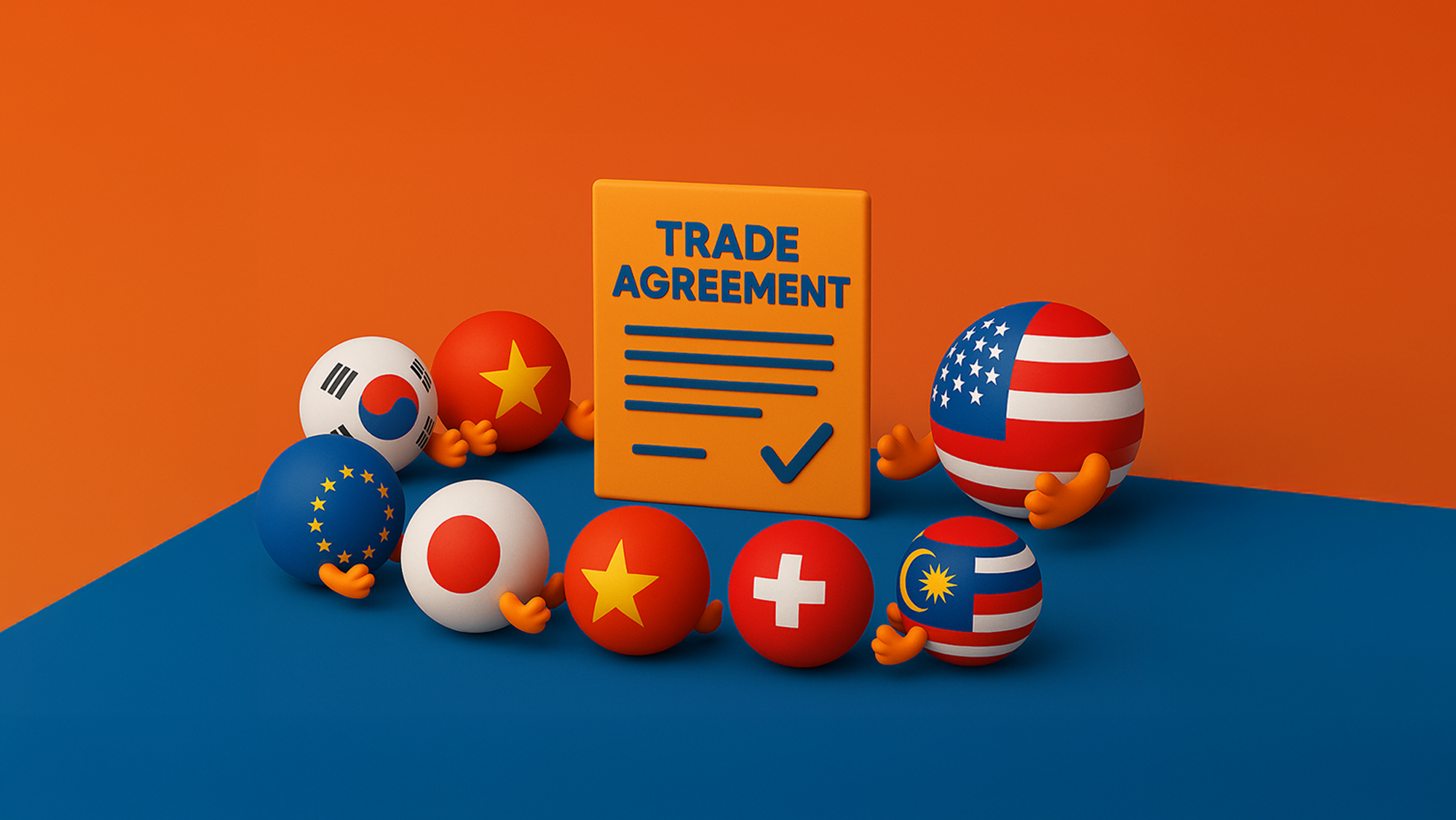
A July 9, 2025 deadline is set to trigger a “tariff bomb” of up to 50% on nations without a U.S. trade deal, signaling a fundamental fracture in the 30-year global trade order.
This article delivers the essential country-by-country analysis and corporate roadmap needed to survive the shakeup.
👉 TL;DR: The Global Trade Shakeup
The Global Chessboard: Key Players & Their Risks
- South Korea: A record surplus puts its critical auto industry directly in the crosshairs.
- European Union: Locked in a stalemate over what it calls “unilateral” and “unreasonable” U.S. demands.
- Japan, India, & Vietnam: Deploying unique, high-stakes strategies from Japan’s “strategic patience” to India’s clash over core interests and Vietnam’s diplomatic gambles.
- Canada & Mexico: Using aggressive tactics, from Canada threatening “counter-tariffs” to Mexico’s data-driven “cap strategy” on steel.
- Other Key Nations: Leveraging unique strengths—like Malaysia’s semiconductor dominance or Switzerland’s precision compromises—to mitigate high tariff threats.
Country-Specific Negotiation Status

South Korea: A ‘Perfect Storm’ from a Record Surplus
- The Core Problem: South Korea is at the epicenter of a ‘perfect storm’. Its record-high trade surplus with the U.S. is now viewed less as a success and more as an ‘original sin,’ making the nation a primary U.S. target.
- Record Surplus: In 2024, the current account surplus with the U.S. hit a record $118.2 billion. The accompanying goods surplus of $66 billion made Korea the 8th largest contributor to the U.S. deficit.
- Political Vulnerability: A recent, prolonged political transition has weakened the country’s negotiating position, forcing a new government to immediately face an assertive U.S. administration.
- Diplomatic Setback: A planned summit at the G7 was canceled due to President Trump’s early departure, eliminating a key opportunity for a diplomatic breakthrough.

Source: US Census Bureau
At-Risk Industries
- High Dependency: Exports constitute over 40% of the South Korean economy, magnifying the impact of any trade disruptions.
- Top Exports to U.S. (2024):
- Car & Auto parts: $41.8 billion (32.7% of total).
- Computer parts: $8.2 billion.
- Non-Volatile Memory: $5.4 billion.
- Automotive Vulnerability: The auto industry, accounting for a third of U.S. exports, is the most exposed and could become the biggest casualty of the negotiations. While Hyundai’s $21 billion U.S. investment plan is a mitigating step, significant exposure remains.
- Semiconductor Time Bomb: While having so far avoided direct tariffs, the semiconductor industry faces a looming Section 232 investigation on “national security” grounds.
- Battery Sector Risk: Even with U.S.-based joint ventures, the battery sector’s reliance on Korean parts means tariffs could severely disrupt both U.S. and Korean EV production plans.
Source: Korea International Trade Association
An Unlikely Shield
- Past Investments: Paradoxically, billions invested by Korean firms in the U.S. under the previous administration are now positioned to act as a potential ‘shield’ against these tariffs.
- Surplus Reduction: This increased U.S. production will naturally lower the trade surplus over time. This effect is already visible, with the May 2025 surplus falling to its lowest level year-over-year.

The European Union (EU): The Giant Dilemma
- Pessimistic Outlook: The prevailing view among officials is that the best-case scenario is no longer a full deal, but simply an agreement to continue talks past the July 9 deadline.
- Core U.S. Demands:
- Imposing ‘fisheries quotas’ that conflict with WTO rules.
- Requiring one-sided tariff cuts from the EU while U.S. tariffs remain.
- Including what officials describe as “far-fetched” economic security demands.
- EU’s Counter-Threat: A retaliatory tariff list on €95 billion of U.S. goods is ready, but the EU’s united front could fracture under pressure.
- Scale of Threat: An estimated €380 billion of goods, representing about 70% of total exports to the U.S., are in the tariff impact zone.

India: A Clash of ‘Core Interests’
- The Standoff: India is caught in a high-stakes negotiation, balancing U.S. pressure against its immovable core interests.
- Looming Tariff: Failure to reach a deal by the deadline will trigger a steep 26% tariff hike on Indian goods.
- The Core Disagreement:
- U.S. Demand: Full market access for its genetically modified (GM) crops.
- India’s Red Line: India maintains that opening its market to GM crops is non-negotiable, demanding instead that the U.S. grant exemptions from existing steel and auto tariffs.
- Diplomatic Vacuum: The canceled G7 meeting between leaders signals a possible deprioritization of India amid shifting U.S. focus.

Vietnam: An ‘All-In’ Bet from the Top
- Aggressive Diplomacy: Vietnam is pursuing a bold, ‘frontal breakthrough’ strategy, with its top leader, General Secretary To Lam, preparing a U.S. visit to negotiate directly with President Trump.
- Tangible “Gifts”: Lam is expected to arrive with concrete offers, including deals for additional purchases of U.S. products designed to reduce Vietnam’s trade surplus.
- Multi-pronged Strategy:
- Pragmatic Deals: Vietnam’s Agriculture Minister has already secured $3 billion in provisional purchase agreements during a tour of U.S. states.
- Private Sector Lobbying: The Trade Minister has been persuading executives from Nike, Gap, and Walmart—all with critical production bases in Vietnam—to support a favorable deal.
- Expected Outcome: A 20–25% base tariff rate is reportedly on the table if Vietnam curbs Chinese transshipment and eases non-tariff restrictions.

Japan: Will ‘Strategic Patience’ Work?
- A Quiet Standoff: The negotiation is a quiet but tense standoff centered on the massive barrier of ‘automotive tariffs’.
- Official Stance: Japan is publicly downplaying the July 9 deadline, stating it will pursue “strategic patience” to protect its national interests above all.
- Intense Undercurrents: Behind this calm facade, diplomacy is fierce, marked by three leader-to-leader calls and six Washington visits by the chief negotiator.
- The Gamble: This strategy is a risky bet. Failure means a 24% tariff hike on all other Japanese goods. Its success hinges on the possibility of an exemption for countries engaged in “good faith” negotiations.
Other Key Nations: A Snapshot
- Thailand: Late Start, High Threat
Entered negotiations late in mid-June and faces a potential 36% tariff. The U.S. is its largest export market, accounting for nearly a fifth of its total exports. - Malaysia: Semiconductor Confidence
Malaysia is leveraging its position as a key “semiconductor ally.” This confidence is rooted in the fact that the United States is Malaysia’s largest single destination for semiconductor exports, with electrical and electronics products making up the majority of Malaysia’s exports to the U.S. - Switzerland: A Precise Compromise
The country is offering partial access to its agricultural market to protect its vital pharmaceutical, machinery, and watch industries. - Canada: The ‘Counter-Tariff’ Card
While engaged in “good faith negotiations,” Canada is openly preparing to raise retaliatory tariffs on U.S. steel and aluminum if talks fail. - Mexico: Logic and a ‘Cap’ Strategy: Mexico is nearing a deal to neutralize the 50% steel tariff by establishing a higher duty-free quota than in the past. Its argument is rooted in data showing the U.S. exports more steel to Mexico than it imports.

Corporate Strategy for a New Trade Order
- Supply Chain Diversification: A Survival Prerequisite.
- Reliance on a single country or region is no longer a viable strategy in the face of geopolitical risk.
- Companies must actively disperse production to regions like Southeast Asia, North America, and India to build resilience.
- Inventory Management: Innovate for Uncertainty.
- Businesses must balance Just-In-Time (JIT) efficiency with Just-In-Case (JIC) flexibility to navigate unforeseen disruptions.
- Maintaining appropriate safety stock levels for strategic materials like semiconductors and battery components is critical.
- Logistics: Diversify Routes and Modes.
- Companies should actively explore multimodal strategies that combine ocean, air, rail, and truck transport.
- Land routes through Canada and Mexico are emerging as key alternatives to potentially disrupted ocean shipping lanes.
- Monitoring: Build a Real-Time Intelligence System.
- The Trump administration’s trade policies are defined by their unpredictability.
- Firms require a robust system to monitor negotiations, tariff changes, and new regulations in real-time to enable a rapid response.
- Investment: Strengthen Local Production.
- Onshoring and nearshoring are becoming core survival strategies to bypass tariff walls and ensure stable market access.
- Digitalization: Achieve Data-Driven Visibility.
- The Foundation: Success in this new era requires knowing exactly “where our cargo is and when it will arrive”.
- The Problem: In an age of unpredictability, a lack of visibility is the biggest risk, and traditional tracking methods are too slow for rapid response.
- The Solution: Digital Supply Chain Visibility platforms, such as TRADLINX ‘Ocean Visibility use AI and machine learning for real-time analysis.
- Accurate ETA Prediction: Preemptively determine if cargo will arrive before tariff hikes or if delays pose a cost risk.
- Real-Time Risk Alerts: Receive immediate notifications of problems like port congestion or route deviations to make faster decisions.
- Integrated Control: Manage a diverse portfolio of shipments on a single dashboard and use analytics to maximize supply chain efficiency.

Why overpay for visibility? Tradlinx saves you 40% with transparent per–Master B/L pricing. Get 99% accuracy, 12 updates daily, and 80% ETA accuracy improvements, trusted by 83,000+ logistics teams and global leaders like Samsung and LG Chem.


Prefer email? Contact us directly at min.so@tradlinx.com (Americas), sondre.lyndon@tradlinx.com (Europe) or henry.jo@tradlinx.com (EMEA/Asia)


Leave a Reply