
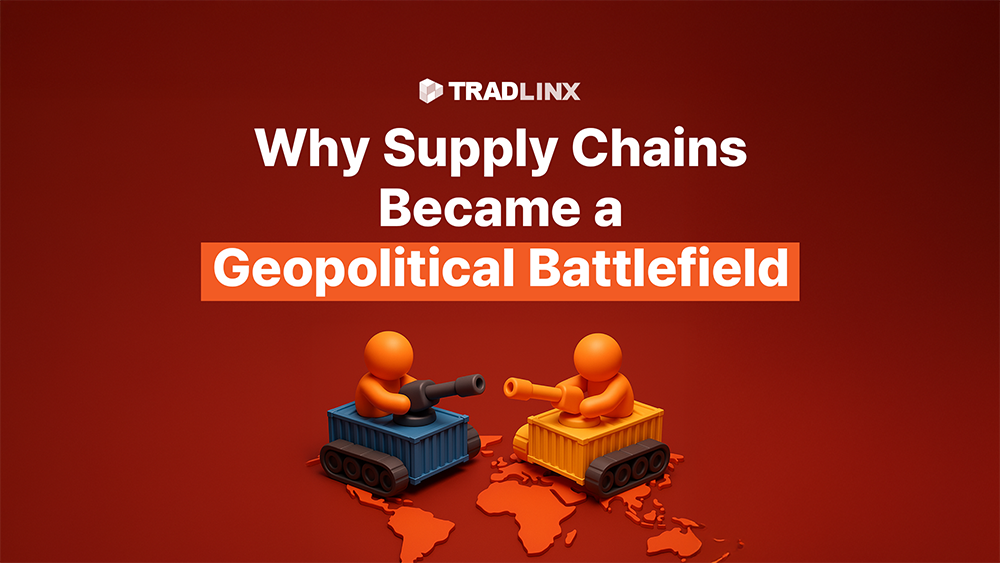
For years, supply chain strategy rewarded the same playbook: lower cost, shorter lead times, and leaner inventory. That logic still matters.
What changed is the number of situations where “business logic” is no longer the only logic. Governments are intervening more directly in ownership, technology transfer, trade controls, and compliance rules, especially in semiconductors, energy, and critical minerals. In practical terms, some supply chain decisions now carry policy risk that can override efficiency.
TL;DR for busy supply chain leaders
- Efficiency still matters, but it is no longer sufficient. Policy and security constraints are now active variables in some industries and lanes.
- Export controls are getting more extraterritorial. Rules can apply based on origin inputs, technologies used, and end use, not just where something is assembled.
- “China+1” reduces risk, but it does not automatically remove it. Dependencies can persist through talent, machinery, tooling, subcomponents, financing, and compliance exposure.
- Your edge is faster, cleaner facts. When policy shifts hit, the teams that respond best are the ones who can map exposure quickly and communicate with evidence.
1) What “government intervention” looks like in a real supply chain
Geopolitics becomes operational when it changes what can be produced, shipped, insured, paid for, or legally controlled.
Example: Nexperia and semiconductor export restrictions
In 2025, the Dutch government intervened in the Dutch chipmaker Nexperia, citing national security concerns. Around the same period, China’s Ministry of Commerce issued export restrictions affecting Nexperia’s China operations, and industry reporting warned of disruption risk for automotive chip supply chains.
2) How supply chains get “weaponized” without a shooting war
Modern pressure often shows up as permits, licensing thresholds, “dual-use” definitions, and compliance triggers that slow or block trade.
Rare earth export controls and “de minimis” thresholds
In late 2025, multiple analyses of China’s updated export control regime described a 0.1% de minimis concept and extraterritorial reach for certain rare earth related items, meaning licensing requirements can apply beyond China’s borders depending on the item, origin inputs, or technologies used. This is not best described as “any product with 0.1% rare earths.” It is more accurate to say: controls can apply to specified categories and can extend outward based on defined thresholds and rules.
3) Regulation can reshape energy and supplier behavior
Geopolitical risk is not only about sanctions. It can also come from regulatory friction that makes certain customer relationships commercially or legally unattractive for suppliers.
EU due diligence rules and Qatar’s LNG warning
Qatar has warned publicly that it could reconsider LNG business with Europe if the EU’s Corporate Sustainability Due Diligence rules are not changed further. Whether or not supply is actually cut, the operational takeaway is that sustainability compliance rules can become a trade and contract negotiation lever, not just a reporting obligation.
4) Why “China+1” sometimes fails to remove dependency
Moving final assembly is often the easiest step. The harder part is removing hidden dependencies such as machinery, tooling, process know-how, specialist technicians, subcomponents, and capital.
India: technician and commissioning constraints
One real constraint has been the difficulty of getting Chinese engineers and technicians into India for installation and commissioning, linked to India’s visa and approval regime after 2020. Reporting has tied these constraints to delayed output and stalled manufacturing projects in sectors that rely on China-origin machinery and specialist skills.
Mexico: nearshoring reduces transit risk, but components can still be China-linked
Mexico is a major nearshoring destination, but “near” does not automatically mean “decoupled.” Many plants still depend on China-origin components, machinery, or upstream inputs. The practical takeaway is not that Mexico is “controlled” by Chinese capital, but that dependency mapping should follow the bill of materials and tooling chain, not the final assembly address.
5) Practical strategy: what to do with this as a CSCO
You do not need to become a diplomat. You do need a repeatable way to answer, quickly, “Are we exposed, where, and through which dependency?”
Four moves that work across industries
- Map dependency beyond Tier 1. Track tooling, commissioning talent, and subcomponent origin for your most critical SKUs.
- Define “policy tripwires.” Decide which events force an immediate review, for example new export controls, sanctions designations, licensing changes, or major regulatory enforcement shifts.
- Contract for change. Write what happens if routing, licensing, or compliance requirements shift mid-contract, including how you will update lead times and responsibilities.
- Invest in faster evidence. When the situation changes, speed and accuracy of internal facts often determines whether you mitigate early or react late.
Where visibility and data quality actually help
In a geopolitically noisy environment, the biggest operational failure mode is slow, inconsistent truth. You cannot manage exceptions if you cannot see them clearly, across suppliers, shipments, and lanes.
Whether you use TRADLINX or another stack, the requirement is the same: accurate event data, frequent refresh, and a shared record that lets teams trace what changed, when it changed, and which flows are exposed.

Further reading
- Reuters: Dutch intervention in Nexperia (Oct 2025)
- Nexperia: Company update on export restrictions (Oct 2025)
- CSET: MOFCOM Notice 2025 No. 61 summary
- IEA: Export controls and critical minerals concentration risk (Oct 2025)
- Reuters: Qatar warning on EU due diligence rules (Oct 2025)
- Financial Times: Chinese technician visa bottlenecks in India
Note: This post is general information, not legal advice. For sanction or export-control decisions, consult counsel and the relevant authorities.
Why overpay for visibility? Tradlinx saves you 40% with transparent per–Master B/L pricing. Get 99% accuracy, 12 updates daily, and 80% ETA accuracy improvements, trusted by 83,000+ logistics teams and global leaders like Samsung and LG Chem.


Prefer email? Contact us directly at min.so@tradlinx.com (Americas), sondre.lyndon@tradlinx.com (Europe) or henry.jo@tradlinx.com (EMEA/Asia)



Leave a Reply