
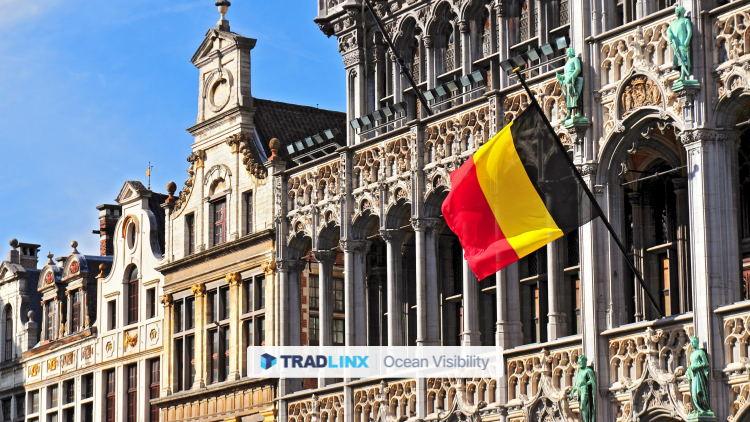
Belgium, strategically located in Northwestern Europe, serves as a crucial hub for international trade. With its advanced transport infrastructure seamlessly integrated into the European network, Belgian ports play a vital role in the nation’s economy. These ports handle over 98% of the country’s international trade volume, contributing €32 billion in direct and indirect value added annually, representing 7% of Belgium’s GDP. The country’s strategic position, bordering France, the Netherlands, Germany, and Luxembourg, and its proximity to the UK, makes it a central nexus for European logistics and distribution.
Here’s an in-depth look at Belgium’s major ports and their key features:
1. Port of Antwerp: Belgium’s Largest Container Hub

Key Features:
- Location: Antwerp, 80 kilometers southeast of the North Sea, and Zeebrugge on the North Sea coast
- Annual throughput: Europe’s second-largest port complex after Rotterdam, handling 289 million tonnes of cargo (2021)
- Employs over 164,000 people (direct and indirect jobs)
- Handles diverse cargo types including containers, bulk goods, and petroleum products
- Features 166 km of quay length and spans an area of 14,000 hectares
- Connected by 1,061 km of railways and 409 km of roads
- Home to Europe’s largest integrated chemical cluster
- Offers over 300 liner services to 800 destinations worldwide
- Pioneering in sustainable initiatives, including shore power facilities and hydrogen projects
2. Port of Zeebrugge: Belgium’s Premier Coastal Port

Key Features:
- Location: Bruges, on the North Sea coast
- Specializes in roll-on/roll-off traffic, containers, and liquefied natural gas
- Deep-water port capable of accommodating ultra-large container ships
- Major hub for automotive logistics, handling over 2.2 million vehicles annually
- Leading European port for LNG, with a capacity of 9 billion cubic meters per year
- Excellent connections to the UK and Scandinavia
- Focuses on green energy initiatives, including offshore wind energy projects
3. Port of Ghent: Vital Inland Maritime Hub

Key Features:
- Location: Ghent, along the Ghent-Terneuzen Canal
- One of Europe’s largest inland ports
- Handles over 48 million tons of diverse cargo annually
- Specializes in dry bulk, general cargo, and liquid bulk
- Strong focus on sustainable development and circular economy initiatives
- Excellent multimodal connections integrating road, rail, and inland waterways
- Key player in the steel, automotive, and agro-food industries
- Home to a bio-based cluster, promoting sustainable industry practices
4. Port of Brussels: Capital’s Strategic Inland Port

Key Features:
- Location: Brussels, along the Brussels-Scheldt Maritime Canal
- Handles primarily containerized goods and bulk cargo
- Annual throughput of about 5 million tonnes
- Offers extensive logistics services
- Plays a crucial role in Belgium’s inland logistics infrastructure
- Facilitates efficient transportation networks, integrating road, rail, and water transport
- Strategic importance for the distribution of goods to the capital region
- Focuses on urban logistics and last-mile delivery solutions
5. Port of Liège: Europe’s Third-Largest Inland Port

Key Features:
- Location: Liège, on the Meuse River
- Third-largest inland port in Europe
- Handles diverse cargo types, including containers, bulk goods, and petroleum products
- Annual throughput of over 21 million tonnes
- Strategic location enhances logistical efficiency for businesses across Europe
- State-of-the-art facilities for efficient cargo operations
- Key hub for multimodal transport, connecting waterways, railways, and roads
- Home to the Liège Trilogiport, a multimodal logistics platform
Economic Impact
The port industry in Belgium has a significant economic impact:
- Contribution to GDP: Ports contribute €32.1 billion in direct and indirect value added, representing 7% of Belgian GDP annually.
- Employment: The sector supports 249,612 full-time equivalent jobs, accounting for 5.9% of Belgian domestic employment including self-employed.
- Trade Value: Belgian ports facilitate the movement of goods valued at over €650 billion annually.
Future Outlook
The future of Belgium’s ports looks promising, with several developments on the horizon:
- Infrastructure Investments: Belgian ports are investing heavily in infrastructure upgrades. For instance, the Port of Antwerp is expanding its container handling capacity with the development of the Saeftinghe Development Area.
- Technological Advancements: Ports are embracing digital technologies to improve efficiency. The Port of Antwerp is implementing a blockchain platform to streamline maritime supply chains.
- Sustainability Initiatives: There’s a growing focus on environmental sustainability. Belgian ports are working towards reducing CO2 emissions, with plans to increase shore power facilities and promote alternative fuels.
- Capacity Expansion: Many ports are planning expansions to meet future demand. The Port of Zeebrugge is developing new areas to accommodate increased container traffic.
- Multimodal Connectivity: Belgian ports are enhancing their multimodal connections. The Port of Ghent is improving its rail and inland waterway connections to strengthen its position as a logistics hub.





Leave a Reply