
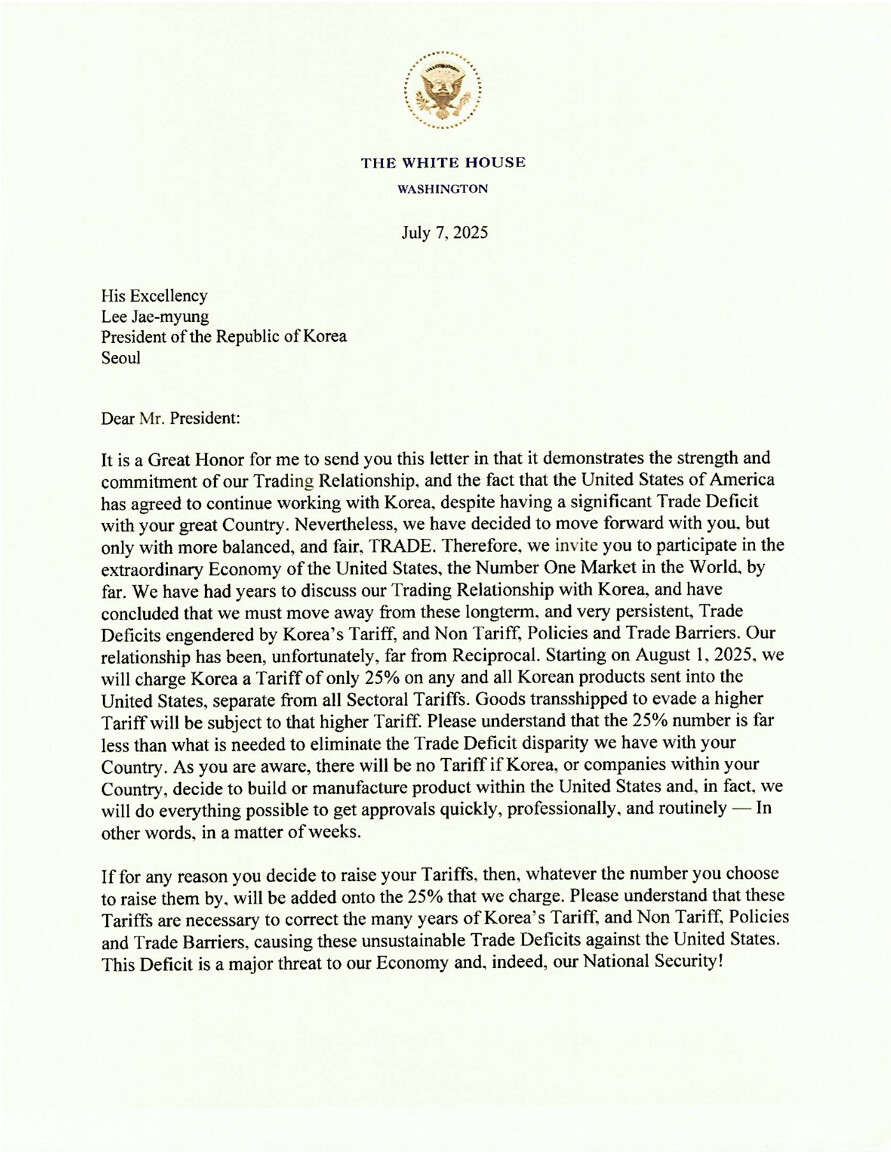
What Happened — South Korea and Japan Served along with 12 Other Nations
On July 7, President Trump publicly posted near-identical letters on his Truth Social platform addressed to South Korean President Lee Jae-myung and Japanese Prime Minister Shigeru Ishiba, notifying them that a 25 percent “reciprocal” tariff will take effect on August 1, 2025, on all imports from their countries.
These announcements were part of a broader wave of trade actions: a total of 14 countries received formal letters, each outlining country-specific tariff rates ranging from 25% to 40%.

Sources: Truth Social, White House Fact Sheet (July 7, 2025)
Timeline – How We Got Here and What’s Next
- April 2, 2025: Trump announces initial plans to impose tariffs on over a dozen countries, citing trade imbalances. South Korea and Japan are named, with preliminary rates reportedly around 24–25%.
- April 5–10, 2025: Markets react negatively. In response, the administration announces a 90-day tariff reduction period, lowering proposed rates to 10% and offering a window for bilateral negotiations.
- May–June 2025: Negotiations stall. The USTR secures only limited agreements (UK, Vietnam), while discussions with Japan, Korea, and China remain unresolved.
- July 7, 2025: Trump officially signs an executive order extending the tariff deadline from July 9 to August 1, and posts formal letters to South Korea and Japan on Truth Social announcing 25% blanket tariffs effective August 1.
- July 7–8, 2025: Additional letters sent to 12 more countries with varying rates from 25% to 40%. A broader list of enforcement actions is expected within the month.
- Next Key Date: August 1, 2025 — Full 25% tariffs take effect unless new agreements are reached.
Despite the aggressive tone, Trump’s letters leave room for modification: tariffs “may be adjusted upward or downward” depending on reciprocal action, market access, and willingness to manufacture within the U.S.
Sector Impact – How the Tariffs Could Hit Automotive, Semiconductors, and Logistics
The 25% tariff announcement—if implemented—could significantly disrupt some of the most critical supply chains linking Asia to the U.S. Here’s how the top sectors may be affected:
Automotive
- South Korea: Hyundai, Kia, and other OEMs rely on exporting assembled vehicles and key components. While many U.S.-bound vehicles are now made in Georgia or Alabama, transmission systems, engines, and modules are often still imported from Korea.
- Japan: Toyota and Honda still export large volumes of cars from Japan to the U.S. The 25% tariff could lead to reduced shipments, price hikes, or supply chain relocation toward North America or ASEAN manufacturing hubs.
Semiconductors and Electronics
- Both countries are foundational to the U.S. tech sector’s supply chain. Samsung, SK hynix, and Toshiba supply NAND, DRAM, and other critical chips used in smartphones, servers, and automotive electronics.
- While many of these are routed through offshore foundries, direct U.S. imports of components like sensors, displays, and memory modules could now face pricing volatility and import substitution.
Logistics and Freight Forwarding
- Any sudden tariff hike alters trade flow volumes and urgency. Importers may front-load shipments in July to beat the deadline, followed by a sharp drop in August volumes.
- Freight forwarders handling U.S.-bound cargo from Busan, Incheon, Tokyo, or Yokohama must prepare for urgent space requests, price swings, and potential rerouting through third countries.
The long-term impact will depend on whether the 25% tariff is enforced broadly, selectively delayed, or ultimately negotiated away. For now, trade professionals should model exposure scenarios and monitor customs bulletins for formal enforcement instructions.
Legal Basis: How Is the 25% Tariff Being Imposed?
The 25% blanket tariffs announced by President Trump are being implemented under the International Emergency Economic Powers Act (IEEPA). This authority allows the president to regulate commerce in response to an “unusual and extraordinary threat” to the national security, foreign policy, or economy of the United States.
- Declared Justification: Trump’s July 7 letters declare a national emergency due to the persistent U.S. trade deficit, particularly with South Korea and Japan.
- Separate from Existing Tariffs: The 25% reciprocal tariff is “separate from all sectoral tariffs,” meaning it applies to products not already covered by higher-priority duties such as Section 232 (autos, steel, aluminum). Under the current tariff-stacking rules, only the highest applicable tariff is charged for each product—tariffs are not cumulatively layered.
While under IEEPA, the tariffs may face WTO scrutiny or domestic legal challenges, especially given their blanket scope and punitive tone.
📌 Clarifying the “Separate from Sectoral Tariffs” Line
The July 7 letter states that the new 25% tariff is “separate from all Sectoral Tariffs.” This does not mean tariffs are stacked.
Under current U.S. customs rules, only the highest applicable tariff is charged. If a product is already subject to a sectoral duty—such as the 25% auto tariff under Section 232—that rate applies, and the new reciprocal tariff does not. If no such duty applies, the 25% tariff kicks in on top of the MFN base rate (which is often 0%).
So while the tariff is “separate” in legal basis, it does not add cumulatively. It applies only when no higher-priority tariff exists.
Strategic Guidance: What Should Logistics & Procurement Teams Do Now?
With the August 1 implementation date fast approaching, logistics and procurement teams operating across U.S.–Korea and U.S.–Japan lanes should take immediate steps to mitigate disruption and cost risk.
1. Audit and Prioritize Exposed SK/JP-Origin SKUs
- Identify products sourced from South Korea and Japan—even indirect components—to assess tariff exposure.
- Check Incoterms on affected shipments. Under CIF or FOB, cost liability may fall on either side of the contract depending on port of handoff.
2. Renegotiate or Split Contracts
- Review whether pricing clauses account for “unforeseen tariffs” and re-negotiate accordingly.
- Consider splitting high-risk SK/JP-origin goods into standalone POs for easier tracking and risk separation.
3. Buffer Lead Times & Consider Alternative Sourcing
- Build in additional lead time for Korean/Japanese imports to absorb potential customs clearance slowdowns post-August 1.
- Explore alternate sourcing or assembly locations to avoid blanket country-of-origin tariffs, especially for transshipped goods.
4. Update Stakeholders & Reprice Where Needed
- Communicate with finance, sales, and customer teams about potential price adjustments or delivery delays.
- Use this opportunity to update your landed cost models, especially in affected verticals like automotive, electronics, and machinery.
TL;DR: Audit. Segment. Buffer. Negotiate. The tariff letters are real, the timeline is short, and the burden is shifting fast.
FTA Conflict & Legal Tensions
The 25% tariff on all imports from South Korea and Japan directly challenges the terms of existing U.S. free trade agreements:
- U.S.–Korea Free Trade Agreement (KORUS): In force since 2012, KORUS eliminates tariffs on nearly all goods traded between the two countries. A blanket 25% duty violates multiple provisions unless justified by a national security exception.
- U.S.–Japan Trade Agreement: While not a full FTA, this agreement covers tariff reductions on agricultural and industrial goods. The newly announced tariffs may breach its terms unless accompanied by renegotiation or a formal withdrawal process.
WTO Risk: These tariffs risk further weakening U.S. standing at the World Trade Organization, especially as WTO members have already challenged similar measures under Section 232 (e.g., steel and aluminum tariffs).
Allies as Targets: The optics of targeting close allies—while emphasizing military alliances—complicates the U.S. diplomatic posture and could impact parallel negotiations with Taiwan, India, and Southeast Asia.
Market Impacts & Industry Sentiment
The tariff announcement triggered immediate concerns among global manufacturers and freight operators:
- Automotive Sector: Hyundai, Kia, Toyota, and Honda face direct cost pressures, especially on vehicles assembled in Korea or Japan for U.S. sale. Suppliers of EV batteries and chips are particularly exposed.
- Semiconductors: U.S. firms dependent on Korean and Japanese chip inputs (SK hynix, Samsung, Renesas) are reassessing sourcing and buffer stock strategies.
- Retail & Electronics: Brands with SK/JP component inputs—including appliances, TVs, and consumer devices—are expected to pass on costs or shift assembly to third countries.
Logistics View: Freight forwarders and 3PLs anticipate rerouting requests, urgent RFQs for transshipment through ASEAN or Mexico, and increased insurance premiums.
Investor View: Equity markets reacted cautiously, with shares of export-heavy conglomerates falling in Seoul and Tokyo. Industry associations have called for clarification and bilateral dialogue.
Conclusion & Final Takeaways
The U.S. decision to impose 25% tariffs on all imports from South Korea and Japan—effective August 1, 2025—marks a turning point in the trade dynamics between allies. It disrupts existing frameworks like KORUS and the U.S.–Japan Trade Agreement, creating new uncertainty across global supply chains.
Key insights:
- Not symbolic: These are real, unilateral tariffs with direct impact on multiple sectors, not just a negotiation tactic.
- Short runway: With less than one month’s notice, manufacturers, importers, and logistics providers must act quickly to adjust contracts and reroute shipments.
- Legal gray zone: The conflict with FTAs and WTO norms will likely spark diplomatic and legal responses from both South Korea and Japan.
- Wider ripple effects: This action may set the tone for additional tariffs on other trading partners, especially in Asia.
Logistics professionals, procurement teams, and exporters must now move from awareness to action—updating cost models, revising Incoterms, and preparing for volatility in cross-Pacific trade.
Planning around new tariffs starts with clear visibility. TRADLINX equips your team with container-level tracking, self-service freight tools, and the control you need to navigate sudden trade risks with confidence.

Common Questions About the New 25% Tariffs
Is the new 25% tariff applied on top of existing tariffs?
No. Under Executive Order 14289, tariffs do not stack. If a product is already subject to a higher-priority tariff (e.g., auto duties under Section 232), that rate applies. The new tariff applies only when no such duty is in place.
Does this tariff affect all products from Korea and Japan?
Yes, unless explicitly exempted. The scope includes all products of origin from South Korea and Japan, regardless of sector, unless separately negotiated.
How is this different from earlier tariffs like Section 301 or 232?
The July 7 action is part of a reciprocal enforcement framework tied to market access and trade barriers. While Section 301 targets unfair practices and Section 232 focuses on national security, this tariff is triggered by unequal treatment of U.S. goods abroad.
What happens if both MFN and reciprocal tariffs apply?
If no sectoral tariff exists, the 25% applies on top of the MFN rate (which is often zero). If a sectoral tariff already applies, only that higher tariff is charged.
When does the tariff take effect?
The tariff applies to entries on or after August 1, 2025. Letters sent in early July confirmed this start date to U.S. trading partners.
Prefer email? Contact us directly at min.so@tradlinx.com (Americas), sondre.lyndon@tradlinx.com (Europe) or henry.jo@tradlinx.com (EMEA/Asia)



Leave a Reply