
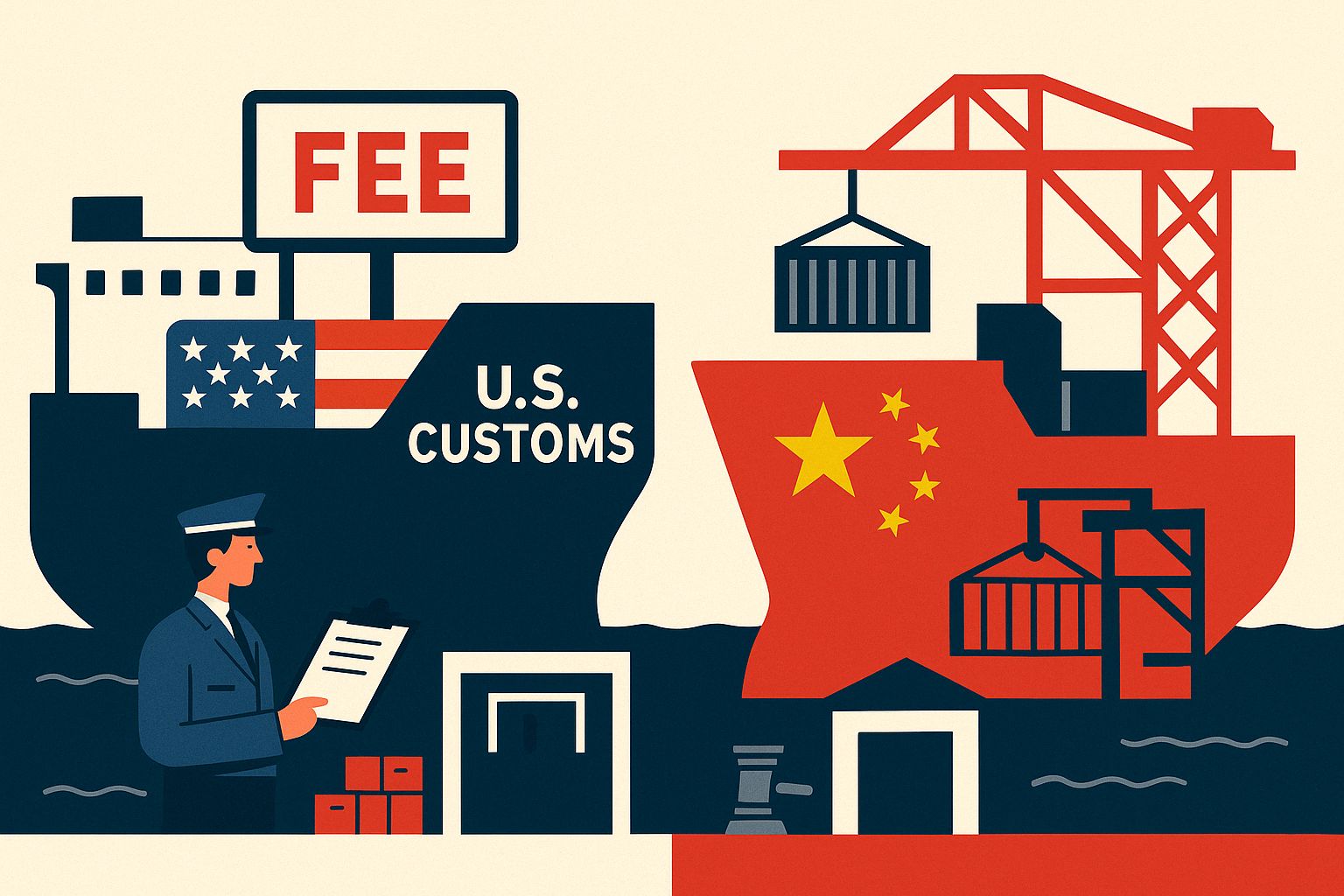
U.S. port fees targeting Chinese-linked vessels are set to begin on October 14, 2025, after months of revisions, public hearings, and industry debate. These fees—part of a broader trade strategy—will impact a range of shipping operations, from large container lines to specialized bulk carriers. Understanding who pays, who’s exempt, and what’s changing next is essential for logistics professionals navigating the evolving regulatory landscape.
In this post, we break down the latest information (as of April 28, 2025) on how these fees work, which vessels are affected, and what exemptions are in place. The policy has evolved significantly from its original draft, so if you’ve followed earlier updates, this guide provides a clear and concise summary of the finalized framework—with key points on what to monitor going forward.
Who Pays the New U.S. Port Fees?
Port fees apply primarily to vessels that are Chinese-owned, operated, or built, depending on specific conditions. The goal is to deter reliance on Chinese maritime assets without disrupting U.S. exporters or smaller regional carriers. Here’s how the fees are structured:
| Vessel Type | Initial Fee (Oct 2025) | Max Fee (April 2028) | Fee Frequency |
|---|---|---|---|
| Chinese-owned or operated | $50 per net ton | $140 per net ton | Up to 5 times/year per vessel |
| Chinese-built (not Chinese operated) | $18 per net ton or $120/container (higher applies) | $33 per net ton or $250/container | Up to 5 times/year per vessel |
| Non-U.S.-built vehicle carriers | $150 per car equivalent unit (CEU) | – | Up to 5 times/year per vessel |
Important Notes:
- Fees are charged per U.S. voyage, not per port call.
- A vessel is charged only one applicable fee per voyage—fees do not stack.
- Each vessel may be assessed up to five times per year under this policy.
Ownership and operational control are key factors. If a vessel is either owned or operated by a Chinese entity (including those based in Hong Kong or Macau), it falls under the highest fee category, regardless of where the ship was built.
Who Is Exempt from U.S. Port Fees?
To avoid disrupting vital supply chains, the U.S. Trade Representative (USTR) has outlined several key exemptions for vessels that meet specific criteria. These exemptions apply mainly to Chinese-built vessels that are not Chinese-owned or operated, as well as certain specialized vessel types and trade routes.
Exemptions for Chinese-Built Vessels
- Empty Arrivals (Ballast): Vessels arriving in the U.S. without cargo are exempt.
- Small Vessels: Container ships ≤ 4,000 TEU, bulkers ≤ 55,000 DWT, or individual bulk carriers ≤ 80,000 DWT are exempt.
- Short-Sea Shipping: Voyages under 2,000 nautical miles to U.S. ports are exempt.
- U.S.-Controlled Vessels: Chinese-built ships majority-owned (≥ 75%) by U.S. persons are exempt.
- Government Program Participation: Vessels enrolled in U.S. maritime security programs like the Maritime Security Program (MSP) or Tanker Security Program (TSP) are exempt.
- Fee Remission Incentive: Operators can apply for a 3-year remission if they order and take delivery of a U.S.-built vessel of similar or larger capacity.
These exemptions are designed to protect U.S. exporters and smaller, regional shipping operations from increased costs, while focusing fees on larger Chinese-controlled shipping networks.
How Are Chinese-Owned or Operated Vessels Defined?
Determining whether a vessel is subject to full U.S. port fees depends on its ownership and operational control. The U.S. has provided detailed criteria to classify vessels as Chinese-owned or operated.
- Ownership: The vessel’s owner is a Chinese citizen, or the company is headquartered in China, Hong Kong, or Macau.
- Control: A Chinese entity holds 25% or more ownership or board representation in the vessel’s owning or operating company.
- Operational Role: The vessel’s operator is listed as Chinese on CBP Form 1300 or holds a Certificate of Financial Responsibility showing Chinese control.
- No Exemptions: If either the owner or operator is classified as Chinese, the vessel is subject to the full fee structure, with no eligibility for exemptions.
This broad definition means that many vessels with partial Chinese interests could fall under the fee regime. Shipping lines must carefully verify their status to avoid misclassification penalties.
What Are the Penalties for Misclassification?
Falsely declaring a vessel as non-Chinese-owned or operated carries serious financial and legal risks:
- Retroactive Fees: Backdated payment of all avoided fees plus penalties of 50–100% of those fees.
- Legal Liability: Potential lawsuits for negligent misrepresentation and criminal charges for submitting false information to U.S. authorities.
- Operational Risks: Vessel detention at U.S. ports, loss of eligibility for fee remissions or exemptions.
To stay compliant, operators should ensure accurate reporting of ownership and control, with updates filed within 30 days of any changes.
Where to Find Official Information and Updates
This policy is evolving, and staying informed is critical. For the most reliable and up-to-date information on U.S. port fees targeting Chinese-linked vessels, consult these official resources:
- U.S. Trade Representative (USTR) Official Releases
- U.S. Customs and Border Protection (CBP) Documentation
- Federal Register Notices
- U.S. Maritime Administration (MARAD) – for programs related to exemptions.
Industry bodies, shipping associations, and legal advisories often provide detailed interpretations as well, but always cross-check with primary sources.
Key Takeaways for Logistics Teams
The new U.S. port fees on Chinese-linked vessels add a layer of cost and compliance considerations for ocean freight planners. While many exemptions exist, especially for smaller or U.S.-controlled ships, staying ahead of these changes is essential to avoid disruptions and unexpected fees.
Here’s how to make sure your operations stay compliant and cost-effective:
Compliance Checklist: Are You Ready?
- ✔ Verify if your vessels are Chinese-owned, operated, or built.
- ✔ Check if your voyages qualify as short-sea shipping (under 2,000 nautical miles).
- ✔ Confirm vessel size: under 4,000 TEU or 55,000 DWT for bulkers = exemption eligible.
- ✔ Ensure your documentation is accurate (CBP Form 1300, Certificate of Financial Responsibility).
- ✔ Review ownership records if Chinese-built but U.S.-owned (75%+).
- ✔ Apply for exemptions early if enrolled in U.S. Maritime Programs (MSP, TSP).
- ✔ Monitor the 5-fee annual cap: plan voyages strategically.
- ✔ Consider U.S.-built vessels for 3-year fee remission eligibility.
Quick Answers You Should Know:
- Is my ship exempt if it’s Chinese-built but arrives empty? Yes, vessels in ballast are exempt.
- Do I pay fees for every U.S. port call? No, only once per U.S. voyage, no matter how many stops.
- What if my vessel is partly Chinese-owned? If 25%+ ownership/control is Chinese, full fees apply.
- How often will fees increase? Annually, through April 2028.
- What’s the risk if I misreport? Retroactive fees, 50–100% penalties, possible detention, legal action.
Quick Reference: Key Dates
| Milestone | Date |
|---|---|
| Fee Policy Announced | April 2025 |
| Grace Period Ends | October 14, 2025 |
| Fee Escalation | Annually through April 2028 |
| Second Phase Begins (LNG carriers) | April 2028 onward |
For teams needing deeper visibility or planning support, consider solutions that offer real-time shipment tracking—helping you adapt as policies evolve. TRADLINX Ocean Visibility helps logistics providers track beyond vessels, down to shipments, with predictive insights and customizable tools.

What This Means for Your Operations
For logistics providers and shippers, these fees add a new layer of complexity to ocean freight planning. While many vessels will remain exempt—especially smaller ships, short-sea routes, and U.S.-controlled vessels—operators relying on Chinese-built or Chinese-operated fleets could see increased costs starting in October 2025.
Staying on top of these regulatory shifts is key to protecting your margins and supply chain efficiency. If your operations depend on Chinese-linked vessels, now is the time to assess alternative routing strategies, evaluate cost impacts, and explore visibility tools that can help you adapt to evolving compliance landscapes.
For teams looking to gain deeper visibility into vessel status and mitigate disruptions, ocean visibility platforms like TRADLINX Ocean Visibility can help you track your shipments proactively—beyond the vessel, to the shipment level.
Need more clarity on how these policies affect your shipments? Reach out to industry experts or consult with your logistics partners to ensure you’re prepared for the coming changes.
Why overpay for visibility? TRADLINX saves you 40% with transparent per–Master B/L pricing. Get 99% accuracy, 12 updates daily, and 80% ETA accuracy improvements, trusted by 83,000+ logistics teams and global leaders like Samsung and LG Chem.


Prefer email? Contact us directly at min.so@tradlinx.com (Americas) or henry.jo@tradlinx.com (EMEA/Asia)


Leave a Reply