
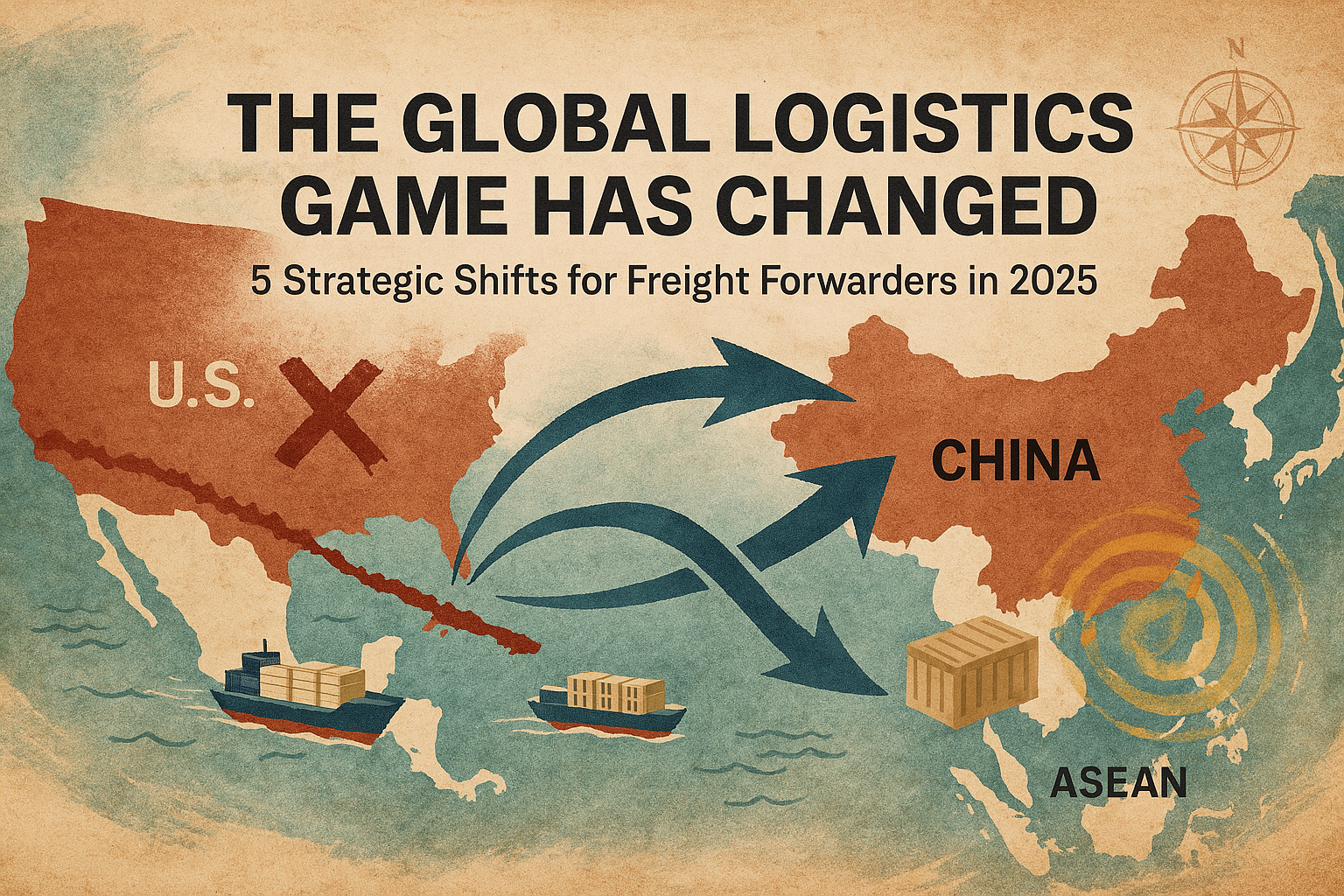
🌏 The Global Logistics Game Has Changed
With US-China tariffs reaching unprecedented levels—up to 145% on Chinese goods—the global supply chain is entering a new phase of fragmentation. China is no longer just retaliating; it’s redirecting. From deepening ties in ASEAN to exploring EU alliances, Beijing is reimagining its trade architecture in real time.
For logistics service providers (LSPs) around the world, this is not just news—it’s a strategic inflection point. Trade routes, volumes, risk exposure, and client needs are all shifting. LSPs must evolve or risk being left behind.
Here are five strategic moves every forward-looking LSP should be making right now:
1. 🧭 Realign Trade Lanes: Follow the Flow Toward ASEAN
With the US market increasingly closed to Chinese goods, Southeast Asia is becoming Beijing’s new export frontier. LSPs should be:
- Optimizing services across Vietnam, Malaysia, Cambodia, and Thailand.
- Enhancing cross-border and multimodal capabilities (especially rail and sea-air).
- Building stronger ties with regional customs, port authorities, and warehousing networks.
🚨 Watchlist: ASEAN trade volumes are projected to outpace US-China freight corridors by mid-2025.
2. ⚖️ Upgrade Compliance: Transshipment is the New Red Flag
As Chinese goods get rerouted through ASEAN and Mexico, the risk of being caught in transshipment violations is rising. LSPs must:
- Implement stronger origin verification protocols.
- Use AI-driven platforms to flag tariff circumvention patterns.
- Proactively educate clients on new trade enforcement risks—especially in the US and EU.
📌 Note: Under new US guidelines, LSPs and 3PLs can be held liable for facilitating unauthorized transshipments—even unintentionally.
3. 🚢 Manage the Overcapacity Wave
China is dealing with a massive export overhang. This will mean:
- Short-term spikes in outbound volume (especially low-value goods).
- Downward pressure on margins due to cheap inventory flooding new markets.
- Sudden policy shifts from regions like the EU (e.g., anti-dumping or import caps).
LSPs should prepare with:
- Flexible contract models.
- Elastic warehouse and carrier capacity.
- Commodity-sensitive routing strategies.
“Initial demand spikes might feel like growth—but they could mask instability.”
4. 🧩 Rethink Global Strategy: From Hubs to Networks
Global trade is no longer structured around a few dominant hubs. It’s becoming more distributed—and more political. LSPs should:
- Build multi-polar network planning models: US-first, China-first, and neutral corridors.
- Explore rising re-export nodes: Mexico, Turkey, UAE, Indonesia.
- Shift from a “lane-based” mindset to a resilience-based strategy.
Hint: The future of global logistics is regionalized, agile, and modular—not linear.
5. 🤝 Become a Trade Intelligence Partner
As clients face uncertainty on tariffs, customs, and cargo risk, LSPs can stand out by offering not just transport—but insight. Ways to lead:
- Create monthly trade route impact reports.
- Offer customs audit advisory and documentation reviews.
- Partner with fintech or regtech firms to provide trade risk dashboards.
LSPs that help clients navigate volatility—not just move freight—will win trust and grow faster.

Prefer email? Contact us directly at min.so@tradlinx.com (Americas), sondre.lyndon@tradlinx.com (Europe) or henry.jo@tradlinx.com (EMEA/Asia)



Leave a Reply