
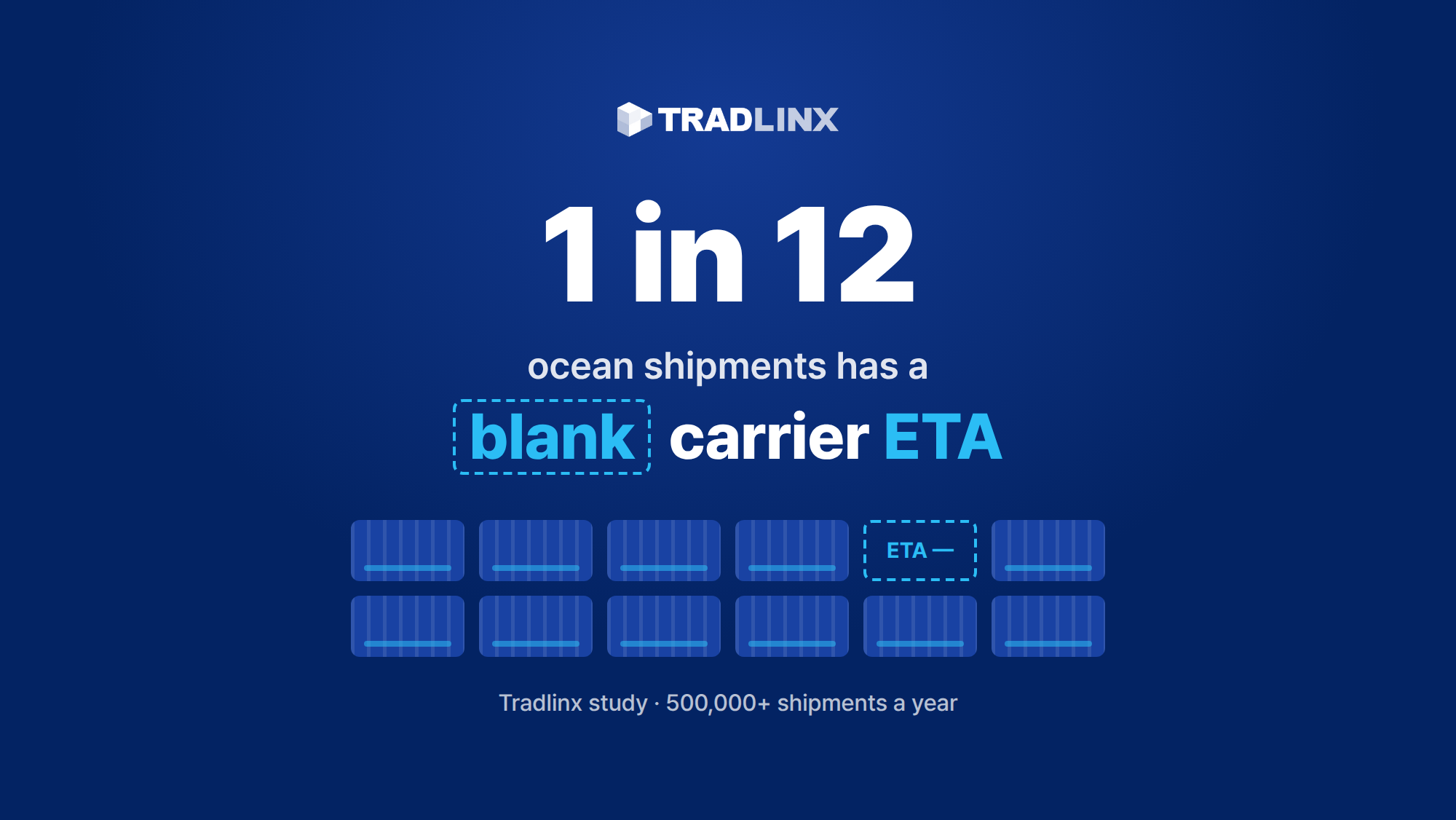
A Tradlinx analysis of more than 500,000 shipments a year finds most gaps occur at transshipment ports, and that carrier ETAs miss by 48 hours or more on 5% of shipments.
October 07, 2026 — Tradlinx, a supply chain data platform based in South Korea, today released findings from an analysis of more than 500,000 ocean container shipments a year, showing that carrier ETAs are not only inaccurate but frequently missing. Carriers left the ETA blank in 42,832 cases, or 8.43% of shipments, most often while cargo was waiting at a transshipment port.
The analysis was carried out while Tradlinx was building and validating AI-ETA, its arrival prediction model.
Key findings
- Carrier ETAs were missing for 8.43% of shipments. Across more than 500,000 shipments a year, carriers left the ETA blank in 42,832 cases.
- Nearly three in four gaps occur at the transshipment port. The ETA for the intermediate transshipment port was missing in 30,929 cases (6.09%), the final-destination ETA of transshipment cargo in 6,168 cases (1.21%), and the destination ETA of direct shipments in 5,735 cases (1.13%). Transshipment cargo accounts for 87% of all gaps.
- Carrier ETAs missed actual arrival by 15.4 hours on average (mean absolute error) across the validation sample.
- 5% of shipments saw carrier ETAs miss by 48 hours or more. In this group of 25,341 shipments (4.99%), the average carrier ETA error was 90.0 hours.

“Most of the industry conversation is about how accurate carrier ETAs are. Our data points to a more basic gap: for roughly one in twelve shipments, the ETA simply goes missing somewhere along the way,” Tradlinx said. “Those blanks cluster at transshipment ports, where planners need visibility most. An empty field rarely triggers an alert, so teams end up checking carrier portals by hand, customer updates slow down, and trucking and warehouse plans are made without a reliable arrival time.”
The findings also suggest the gaps can be closed with prediction rather than by waiting on carrier updates. Because the same shipments were used to validate AI-ETA, Tradlinx could compare the model’s estimates with carrier ETAs shipment by shipment. The model produced an estimate wherever the carrier ETA was missing, and its average error came in 31.4% lower than that of carrier ETAs, at 10.6 hours versus 15.4 hours. The difference was largest where carrier ETAs went furthest off course: on shipments missed by 48 hours or more, average error fell from 90.0 hours to 9.2 hours.

Methodology
The analysis is based on 508,055 ocean container shipments tracked in Tradlinx Ocean Visibility with actual arrival confirmed by March 2026. Carrier ETAs and AI-ETA predictions were compared at the same point in time. Error is measured as mean absolute error (MAE) in hours, and percentages are calculated from unrounded values.
More detail on the findings is available at https://www.tradlinx.com/intelligence/ai-eta
About Tradlinx
Tradlinx is a unified logistics data platform that connects global supply chain stakeholders and systems with reliable, actionable data. Since launching Korea’s first export-import logistics platform in 2015, Tradlinx has served more than 60,000 businesses, tracked over 13 million containers and built 98% global carrier coverage. Its flagship product, Tradlinx Ocean Visibility, is used by more than 3,000 companies worldwide. AI-ETA, Tradlinx’s arrival prediction model, delivers a most-likely arrival time together with earlier- and later-arrival scenarios for ocean shipments. Learn more at www.tradlinx.com.
Media contact
Tradlinx Global marketing team
[mins@tradlinx.com]


Leave a Reply