
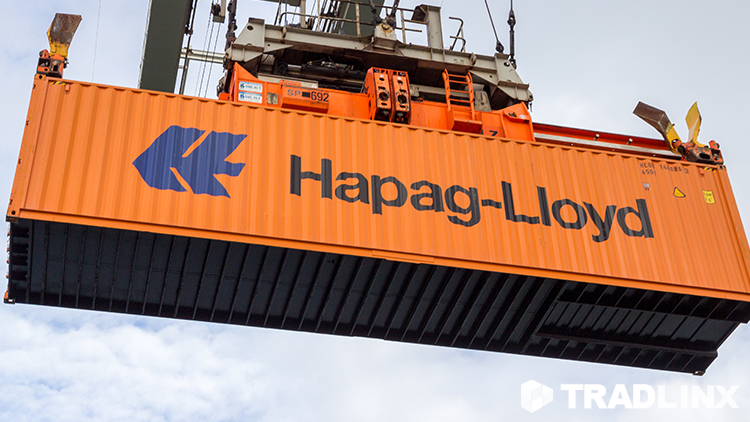
A feeder out of a port in the Republic of Ireland slips, and your laden export container sits on the quay waiting for it. Hapag-Lloyd Ireland published a local arrangement on November 12, 2026 under which the export storage and demurrage from that kind of wait can be avoided, provided a set of conditions holds.
The first condition is a timestamp. The feeder Estimated Time of Sailing (ETS) shown on your latest Booking Confirmation must have reached you at least 48 hours before you collected the empty container from the nominated depot. If you cannot show when that Booking Confirmation arrived and when the box left the depot, you have nothing to show the carrier, however clearly the feeder delay was outside your control.
Below: what export demurrage is, the conditions in the Irish rule, how Hapag-Lloyd’s Central European exports and Maersk’s US exports treat the same event, and what to capture at booking so the argument exists when the invoice arrives.
What is export demurrage?
Export demurrage is the carrier’s charge for a loaded export container that stays at the origin port terminal longer than the free time allowed before loading. The clock starts when the full container is delivered to the terminal and stops at loading or vessel departure, so a sailing that moves later lengthens the stay. At Hapag-Lloyd in the Republic of Ireland, the export tariff lists export demurrage (DMO) and export storage (STO) as separate charges and counts both in calendar days, from gate-in full at the carrier’s designated terminal until vessel departure.
Import demurrage is the version most guides explain: the box lands, free time starts, and the last free day is the deadline the consignee works against. Our Demurrage & Detention definitions guide covers that side, and Carrier LFD vs Terminal LFD explains why an import invoice can follow two clocks. On the export side, the end of the clock is a vessel departure the shipper does not control.
A 2015 US Federal Maritime Commission staff report on D&D practices at selected US ports describes export demurrage free time as the number of days before sailing that a loaded container can arrive without storage charges. It also found that carrier notice terms for rolled bookings may not meet the time constraints of some exporters.
How does a feeder delay create export demurrage?
A feeder delay creates export demurrage when the laden container is delivered to the quay for the original sailing and the feeder then leaves later, so the container’s time on the quay runs past its free time. The tariff clock counts days on the quay whatever the reason the vessel moved. Relief, where it exists, comes from a separate carrier rule with its own conditions.
The FMC’s 2015 report documented how carriers and terminal operators administered demurrage and free time at selected US ports, with responsibilities varying by arrangement. Those findings do not establish who has waiver authority at Irish terminals. For an Irish export booked with Hapag-Lloyd, start with its local 48-hour notice and applicable export tariff.
What is Hapag-Lloyd’s 48-hour rule for export storage and demurrage in Ireland?
Hapag-Lloyd’s 48-hour rule is a local arrangement in Ireland, published November 12, 2026, under which export storage and demurrage charges resulting from feeder delays are avoided when stated conditions are met. The central condition is that the feeder ETS on the latest Booking Confirmation was received at least 48 hours before equipment collection from the nominated depot. Hapag-Lloyd describes it as giving customers more time to adjust load plans and laden return dates.
The notice groups its conditions under three headings. For operational purposes, they can be broken into four evidence checks:
| Test | What the notice requires | Evidence to retain |
|---|---|---|
| 1. Feeder schedule | The feeder ETS shown on the latest Booking Confirmation was received at least 48 hours before equipment collection from the nominated depot | Each dated Booking Confirmation version with its receipt time, and the empty gate-out time at the depot |
| 2. Load plan and laden return | The load plan and laden return to quay date are aligned with the latest feeder sailing date communicated before equipment collection | Versioned load and haulage plans, together with the latest feeder sailing date communicated before collection, including any carrier update after the Booking Confirmation |
| 3. Free time on quay | The applicable free time on quay is observed, per Hapag-Lloyd’s latest published Detention and Demurrage Tariffs | Container type, the applicable free time, gate-in full time, and the planned, revised and actual feeder departures |
| 4. Documentation | All required documentation, including VGM, MRN and Shipping Instructions, is submitted within the applicable cut-off times | Submission time of each document against its cut-off |
For UK and Ireland feeder shipments, Hapag-Lloyd’s Europe operational updates say that Booking Confirmations link to applicable quay free-time and subsequent storage and demurrage charges, and that the Shipping Instructions cut-off aligns with the VGM, MRN or UCR, and DGN cut-offs. In the Irish export tariff effective August 1, 2023, quay free time for demurrage and storage is 7 calendar days for dry containers and 5 for reefers and special equipment, at both Dublin and Cork/Ringaskiddy.
What the notice leaves open. The published notice does not specify a separate effective start date or explain how a revised Booking Confirmation received within 48 hours before a planned collection is treated. It also leaves open how the requirement to observe quay free time is assessed when the feeder delay itself is what pushes the stay past free time. Ask Hapag-Lloyd Ireland to confirm all three in writing before you rely on the rule for a specific booking.
Worked example: one feeder delay, two eligibility scenarios
Booking A. Version 2 of the Booking Confirmation arrives Monday at 09:00 with a feeder ETS of Thursday. The haulier collects an empty dry container from the nominated depot Wednesday at 10:00, 49 hours later. The laden container gates in at the Dublin terminal Wednesday at 17:00, in line with the Thursday sailing, with VGM, MRN and Shipping Instructions filed before cut-off. The feeder then slips to Friday of the following week, which takes the stay past the 7 calendar days of quay free time for a dry container. Booking A clears the 48-hour test with an hour to spare. Whether the quay free time condition is read as met when the delay itself caused the overrun is the point to get confirmed.
Booking B. Same booking, but version 3 of the Booking Confirmation arrives Tuesday at 15:00 moving the feeder ETS to Friday. Collection still happens Wednesday at 10:00, 19 hours after the latest Booking Confirmation. On a strict reading of the notice, test 1 fails: the ETS on the latest Booking Confirmation was not received 48 hours before collection. Both bookings share the same cause of delay. Booking B’s exposure comes from a 19-hour gap, which moving collection to Thursday 15:00 or later would have closed, provided no newer version arrived and the later collection still fit equipment availability, stuffing and cut-offs.
The notice does not say whether a late revision removes eligibility outright, so confirm Booking B’s treatment with Hapag-Lloyd Ireland. Until you have that answer, treat a revision that lands within 48 hours of a planned collection as a decision point: move the collection, or accept that the waiver may not apply. Neither booking is a guaranteed waiver; in both, the evidence decides the conversation with the carrier.
Does a feeder or vessel delay waive export demurrage at other carriers?
It depends on the carrier and the origin country, and a rule from one cannot be assumed for another. Hapag-Lloyd applies a different notice test to exports from six Central European countries, measured in working days against the planned positioning or empty pick-up date. Maersk’s US export terms describe schedule-change relief for detention, with a separate rule for demurrage.
| Carrier and origin | Relief rule | Measured against | Charge covered | Source |
|---|---|---|---|---|
| Hapag-Lloyd, Ireland | Feeder ETS on the latest Booking Confirmation received at least 48 hours before collection, plus load plan, quay free time and documentation conditions | Equipment collection from the nominated depot | Export storage and demurrage resulting from feeder delays | Local notice, Nov 12, 2026 |
| Hapag-Lloyd, Germany, Austria, Switzerland, Slovakia, Czech Republic, Hungary | Demurrage does not apply if an ETD change is communicated less than 5 working days before the planned date | Planned container positioning (carrier haulage) or empty pick-up date (merchant haulage) | Demurrage | Local notice, May 2026 |
| Maersk, United States | If the earliest receipt date publicly communicated by the terminal changes while the container is in the customer’s possession for stuffing and within free time, detention free time is extended by the working days between the old and new date | Earliest receipt date | Detention | US export local information; tariff effective Jan 1, 2026 |
Both Hapag-Lloyd rules protect the shipper from schedule changes it had no time to plan around, and both measure that with a timestamp. Ireland asks whether the schedule you collected against had been on the Booking Confirmation for 48 hours. The Central European rule waives demurrage when an ETD change reached you less than five working days before positioning or pick-up.
Maersk’s US export page works differently. For standard dry containers, demurrage free time is generally 7 calendar days, starting the first calendar day after the equipment arrives at the loading port. The applicable tariff provides different allowances for other equipment: operating reefers generally receive 5 working days, with shorter free time at certain ports. Maersk separately addresses containers gated in before the earliest receipt date and containers that miss their originally scheduled vessel for reasons other than carrier error. Under the missed-vessel provision, demurrage is assessed according to the applicable tariff until loading or the scheduled vessel departure, whichever comes first. The earliest-receipt-date extension described on the page applies to detention free time; it does not automatically extend demurrage free time.
Disruption-wide measures behave differently again. The extension covered in Maersk Hormuz Update 9 applied across affected bookings, while the Irish rule is applied booking by booking, on evidence.
Two notes on regulation. The FMC’s billing rule at 46 CFR Part 541 governs demurrage and detention invoices issued by ocean common carriers within the Commission’s jurisdiction over US foreign commerce, so an Irish or German origin alone does not settle whether an invoice is covered; a shipment bound for the US may be. The local tariff and contract still define the charge itself. Separately, in 2022 the FMC’s National Shipper Advisory Committee drafted a recommendation that the earliest receipt date in force when the empty container is picked up should govern the shipment. It has no force as a rule, but it anchors on the same moment as Hapag-Lloyd Ireland’s test: equipment collection.
What evidence do you need to dispute export demurrage after a feeder delay?
You need the timestamps the waiver tests: when each Booking Confirmation version arrived, when the empty left the depot, when the laden container gated in at the quay, when each document was filed, and when the feeder actually sailed compared with each ETS you were given. The Hapag-Lloyd notice does not make fault a separate condition, so the shipment timeline is the stronger basis for a request.
Those timestamps rarely sit in one place. Booking Confirmation versions are in an inbox or booking system. Empty gate-out and laden gate-in are container events recorded by the depot, the terminal and the carrier. Document filings sit in carrier or customs portals. The feeder’s ETS history is the hardest to recover, because schedule pages usually show the current estimate and overwrite the ones before it.
So the problem shows up weeks later. The origin invoice arrives, and the team has to rebuild a timeline that includes an ETS nobody saved. If your team reconstructs these timelines from inboxes and carrier portals each time an origin invoice lands, walk through how ops teams keep container milestones and schedule changes on one timeline.

Where Tradlinx fits
Tradlinx Ocean Visibility records container milestones such as pick-up, gate-in at the load port and loading on vessel, together with vessel schedule updates, across carriers in one view with their timestamps. That helps rebuild the operational half of the timeline behind a disputed charge.
How to dispute an export demurrage invoice after a feeder delay
- Identify the charge and the origin. Hapag-Lloyd’s Irish export tariff names the charges export demurrage (DMO) and export storage (STO). Check the billed charge, container type and terminal against the booking.
- Match the event to the rule. Cite the November 12, 2026 local notice and state which feeder change caused the extra quay time.
- Attach the four tests in timeline order. Booking Confirmation receipt times, empty gate-out, laden gate-in, document filings, and the feeder’s ETS history against its actual departure.
- Send it through the carrier’s dispute channel. Hapag-Lloyd Ireland’s local FAQ points to its online invoice dispute form, which requires a registered Hapag-Lloyd account. Ask local customer service to clarify any condition the notice leaves open.
- Check the arithmetic separately. The free time count, start time and end time can be wrong even when the waiver does not apply. Demurrage Billing Errors sets out the audit method.
For invoices that fall under FMC jurisdiction, the reach-back window for older charges is covered in How Far Back Can You Challenge Demurrage Charges?. Origin-side LO-LO charges in India follow their own collection rules, covered in India Empty-Container LO-LO Fees.
Export demurrage checklist: what to capture at booking
- Every Booking Confirmation version, with its receipt time, and a note of which version was in force at collection.
- The 48-hour check before collection (Hapag-Lloyd, Ireland): is the latest Booking Confirmation at least 48 hours old? If a revision landed inside that window, decide whether to move the collection.
- Empty gate-out and laden gate-in times for each container.
- A laden return date set to the latest feeder sailing, inside the quay free time linked from the Booking Confirmation.
- VGM, MRN and Shipping Instructions filing times against each cut-off.
- The feeder’s ETS history: each change, with the date and time you received it.
- Central European exports with Hapag-Lloyd: when each ETD change was communicated, counted in working days back from the planned positioning or empty pick-up date.
- Maersk US exports: each earliest receipt date the terminal publicly communicates, and any change while the container is in your possession and within detention free time.
Frequently asked questions
What is export demurrage?
Export demurrage is the carrier’s charge for a loaded export container that stays at the origin port terminal beyond the free time allowed before loading. It typically runs from gate-in full at the terminal until loading or vessel departure, so a later sailing lengthens the time charged.
What is the difference between export demurrage and export detention?
Export demurrage covers the loaded container’s time at the origin terminal. Export detention covers the carrier’s equipment while it is outside the terminal, from empty pick-up until the laden container is returned. At Maersk in the United States, export detention free time is generally calculated in working days, although detention charges are invoiced per calendar day. Export demurrage free time depends on equipment type and location: standard dry containers generally receive 7 calendar days, while operating reefers have different working-day allowances.
Does a feeder delay automatically waive export demurrage?
No. Relief depends on the carrier’s local rules. Hapag-Lloyd Ireland waives export storage and demurrage from feeder delays only when the feeder ETS on the latest Booking Confirmation was received at least 48 hours before equipment collection and the load plan, quay free time and documentation conditions are also met.
What is Hapag-Lloyd’s 48-hour rule in Ireland?
It is a local arrangement published November 12, 2026 that avoids export storage and demurrage charges resulting from feeder schedule changes when four things hold: the feeder ETS on the latest Booking Confirmation was received at least 48 hours before equipment collection, the load plan and laden return match the latest feeder sailing date, quay free time is observed, and VGM, MRN and Shipping Instructions meet their cut-offs.
Do FMC demurrage rules apply to exports from Ireland or Germany?
Not automatically, and the origin port alone does not rule them out. The FMC’s billing rule governs D&D invoices issued by ocean common carriers within its jurisdiction over US foreign commerce, which can include a shipment bound for the US. The carrier’s local tariff and contract still define the charge.
Further Reading
- Hapag-Lloyd: Ireland, Update on the 48-hour rule for export storage and demurrage charges
- Hapag-Lloyd: Update on demurrage application in export shipments
- Hapag-Lloyd: Republic of Ireland export demurrage and detention tariff
- Hapag-Lloyd: Week 23 Europe Operational Update
- Maersk: United States export local information
- FMC: Rules, Rates, and Practices Relating to Detention, Demurrage, and Free Time (2015)
- FMC National Shipper Advisory Committee: Draft ERD recommendation (2022)
Sources and dates: Hapag-Lloyd Ireland 48-hour rule, local notice published November 12, 2026. Hapag-Lloyd Central Europe export demurrage application (Germany, Austria, Switzerland, Slovakia, Czech Republic, Hungary), local notice, May 2026. Hapag-Lloyd Republic of Ireland export demurrage and storage calculation and free time, export tariff effective August 1, 2023. Maersk US export free time and earliest receipt date terms, US export local information page, tariff effective January 1, 2026. FMC staff report on detention, demurrage and free time at selected US ports, April 3, 2015. 46 CFR 541.2 scope. FMC National Shipper Advisory Committee draft ERD recommendation, 2022. No per-day tariff rates are quoted in this post. Thresholds and conditions are carrier- and country-specific; confirm against your own carrier tariff, local terms and contract before relying on them.
Need help interpreting this disruption or your shipment?
For a quick question, chat with Tradlinx on WhatsApp. For a deeper discussion, book a time below.


Leave a Reply