
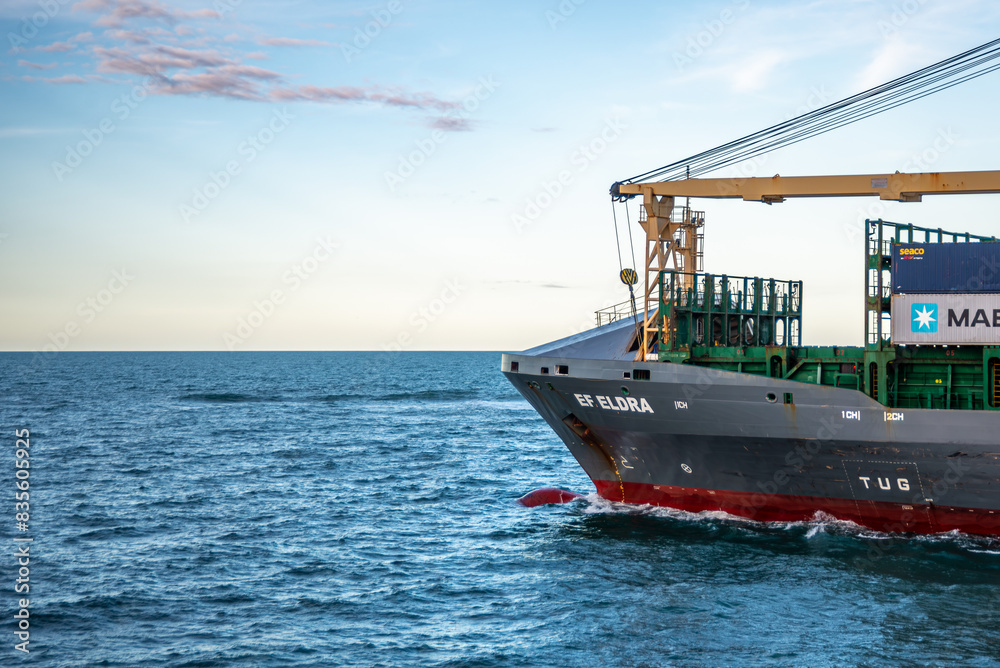
Maersk will discontinue its A04 intra-Asia shuttle and fold the coverage into an enhanced A14 service from late September. The final A04 sailing is Seaspan Lingue 639S, with an ETA at Dalian of 23 September 2026.
Maersk says alternative routing solutions have been offered to affected customers where required, while detailed vessel and voyage information will be reflected in its online schedules and usual booking channels. For cargo moving through the transition, the assigned vessel, voyage or transshipment plan may therefore change. That is where the exposure sits for anyone with boxes moving through North China and South Korea this month.
What Maersk Published, and When
The advisory was issued on 4 September 2026, three days ahead of the trade-press coverage that carried it more widely. It sets out three transition sailings and one rotation for the enhanced service.
| Service | Direction | Vessel / Voyage | First load port | ETA at first load port | Status |
|---|---|---|---|---|---|
| A04 | Southbound | Seaspan Lingue 639S | Dalian | 23 Sep 2026 | Final A04 sailing |
| A14 | Eastbound | Ute 639E | Xingang | 26 Sep 2026 | First sailing under the new setup |
| A14 | Southbound | Seaspan Lingue 640S | Xingang | 29 Sep 2026 | First sailing under the new setup |
Maersk describes the merger as a move to improve schedule reliability and service consistency while holding connectivity across North China and Southeast Asia. Detailed vessel and voyage information sits in the online schedules rather than in the advisory itself.
The Rotation, Port by Port
The rotation is the part worth reading closely, because the port list is what determines whether a given container still has a connection.
| Service | Rotation | Status |
|---|---|---|
| A04, current | Dalian – Tianjin – Busan – Shanghai | Discontinued after the 23 September sailing |
| A14, current | Tianjin – Tanjung Pelepas – Singapore – Xiamen – Busan | Replaced by the enhanced rotation |
| A14, enhanced | Xingang (S) – Tanjung Pelepas – Singapore – Xiamen – Busan – Xingang (E) – Dalian – Busan | From late September 2026 |
Shanghai appears in the current A04 rotation and does not appear in the enhanced A14 rotation. Maersk’s advisory neither names Shanghai nor gives a reason for the omission, so the change is visible only by comparing the two port lists.
Dalian and Busan both survive the merger. Both were A04 calls, and both appear in the enhanced A14 rotation, which is what Maersk means by incorporating the relevant cargo coverage.
One point needs care. Trade-press coverage of the change described Busan calls falling from two a week to one. The rotation Maersk published lists Busan twice, once after Xiamen and once after Dalian. Teams planning around Busan connectivity should work from the published rotation and confirm the call pattern in a schedule query against their own vessel and voyage.
The Six Days Between the Last A04 and the First New Southbound
The last A04 southbound has an ETA at Dalian of 23 September. The first southbound under the new A14 setup has an ETA at Xingang of 29 September, with the first eastbound sailing under the new setup scheduled from Xingang on 26 September. That creates a transition window in which cargo previously planned around the A04 needs to be checked against its actual reassigned routing rather than assumed to move on the same sequence.
The sharper exposure is on transshipment. Trade reporting describes the A04 as feeding North Chinese and South Korean shipments into mainline services at Shanghai. With Shanghai absent from the enhanced A14 rotation, cargo previously planned around that connection needs to be checked against the routing now assigned to the shipment.
Maersk states that alternative routing solutions have been offered to affected customers where required. Where a forwarder holds the booking, the cargo owner may not receive that carrier communication directly, so the reassigned routing is worth checking against the shipment itself.
A service merger can change the vessel, voyage or transshipment path attached to a shipment during the transition. For operations teams, the important check is whether the routing currently assigned to the container still matches the original plan.
The Congestion Backdrop
The handover lands in an active congestion window in the same basin. Kuehne + Nagel reported a seven-day average vessel waiting time of about 3.45 days at Ningbo on 1 September, with yard occupancy at 92–95%, while Seaexplorer data from 4 September put Shanghai’s average wait at 5.46 days. Linerlytica’s 8 September update puts vessel waits at up to 12 days in Shanghai and Ningbo, with more than 4 million TEU of vessel capacity tied up by global port congestion.
Maersk does not cite congestion as a reason for the merger, and the advisory makes no reference to it. The relevance for planning is narrower: a rotation change taking effect during a period of elevated berth waits gives less slack for a missed connection to recover. The reliability picture at Shanghai sets the baseline this transition runs against.
If your team is reconstructing which boxes moved on which vessel after a service change by cross-checking booking confirmations against carrier schedules, walk through how ops teams see vessel and voyage reassignments at container level as they happen.

What to Re-Check This Week
- Which open bookings name A04 as the intended service, and which vessel and voyage each is assigned to now
- Any container previously planned to transship at Shanghai on the shuttle, and the routing it has been moved to
- Your own cut-off against the 23 September ETA at Dalian if you are trying to make the final A04 sailing
- Whether your forwarder received the alternative routing Maersk says was offered to affected customers, and on which bookings
- The Busan call pattern on the enhanced A14, checked in a schedule query rather than taken from a summary
- Whether berth waits at Shanghai and Ningbo move again during the handover period
Need help interpreting this disruption or your shipment?
For a quick question, chat with Tradlinx on WhatsApp. For a deeper discussion, book a time below.
Prefer email? Contact us directly at min.so@tradlinx.com (Americas), sondre.lyndon@tradlinx.com (Europe), or henry.jo@tradlinx.com (EMEA/Asia).
Further Reading
- Asia Shuttle Network Update Integration of A04 into A14 (Maersk, 4 September 2026)
- Gemini partners to omit Shanghai call in Asia shuttle shake-up (The Loadstar, 7 September 2026)
Transition sailings, vessel and voyage references, first load ports, ETA dates and the enhanced A14 rotation are taken from Maersk’s advisory of 4 September 2026. The current A04 and A14 rotations and the description of the A04 as a feeder into mainline services at Shanghai are as reported by The Loadstar on 7 September 2026. Kuehne + Nagel congestion figures are from its late-August operational update, while the latest Linerlytica congestion figures cited above are from 8 September 2026. Maersk’s advisory does not reference Shanghai, congestion or Busan call frequency. Dates shown are ETA at the first load port and are not departure dates; confirm your own cut-offs, vessel and voyage assignment and call pattern against Maersk’s online schedules and your booking confirmation.




Leave a Reply