
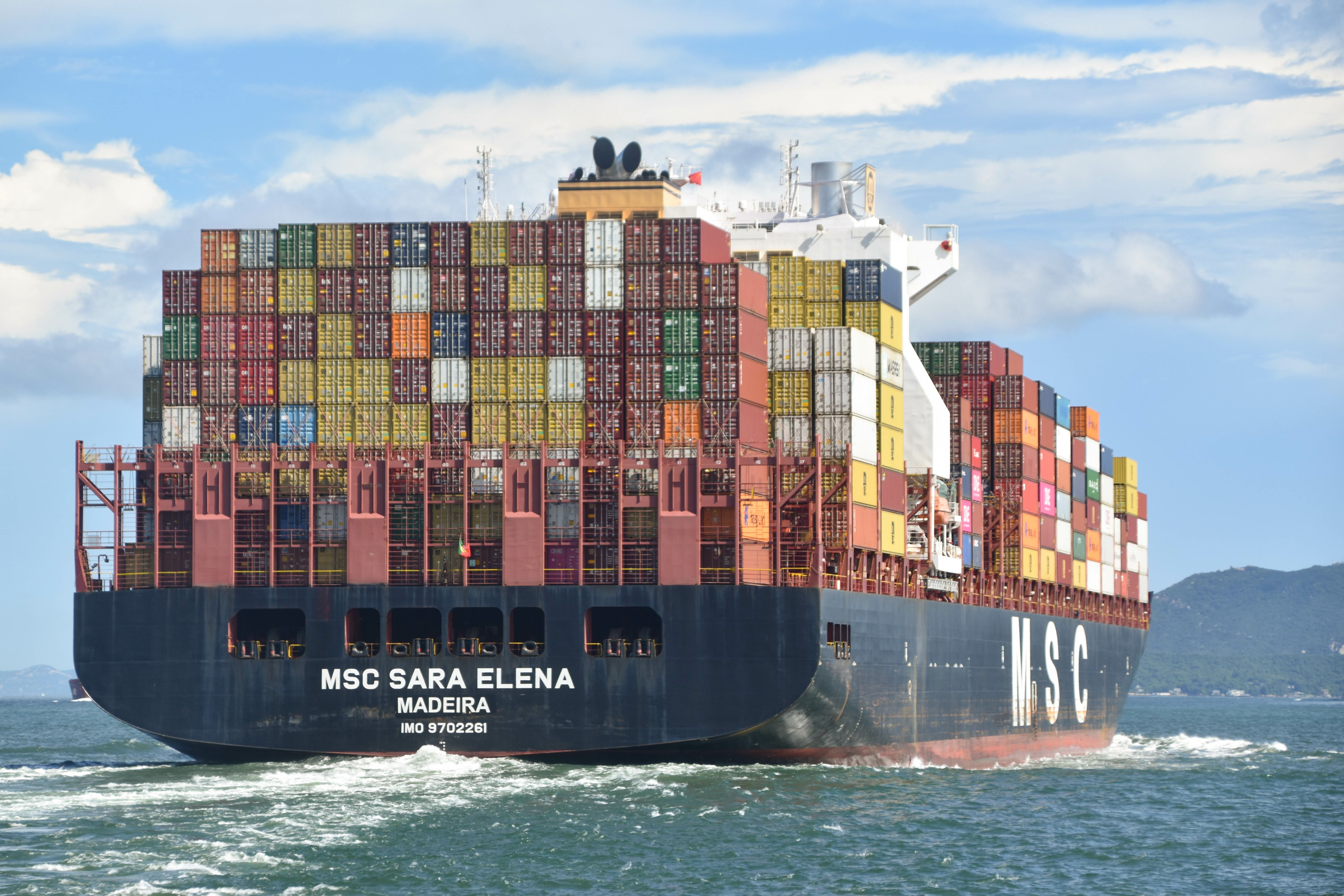
If you have Gulf cargo on the water booked to Khor Fakkan, the port named on your B/L may not be the port where the container lands. Maersk’s Middle East Operational Update 46, published 11 September 2026, confirms that selected shipments booked with a final port of discharge of Khor Fakkan are being discharged at Fujairah instead, then moved under bonded landside transport to Jebel Ali, with the final port of discharge formally changed to Jebel Ali (via Fujairah).
That change can force teams to re-check the customs entry, delivery order, haulier booking, empty return instruction and Demurrage & Detention tariff that applies to the box. Maersk says impacted customers are contacted separately with shipment-specific details, so the change can arrive one booking at a time rather than through a single schedule update covering every affected shipment.
What Changed on 11 September
The change-of-destination clause is new relative to Update 44 of 31 August, which carried the same landbridge and surcharge structure without it. Update 46 adds a section headed “Change of Final Destination: Selected Khor Fakkan Shipments to Jebel Ali,” and states that the associated transport, clearance and storage costs fall under Maersk’s applicable Terms for Carriage.
Two surcharge notices landed in the same window. Maersk announced an Emergency Operational Cost Recovery Surcharge (OCR) on 9 September for contract bookings to the UAE from worldwide origins excluding Far East Asia. A second notice followed on 11 September for Bahrain, Qatar, Kuwait and Iraq. The notices carry different effective dates depending on market scope, so check the advisory matching your origin and destination rather than treating the publication date as the start date.
Everything below is Maersk’s published arrangement. Other carriers run their own Gulf contingencies with different hubs, different suspended cargo types and different empty return rules. Do not assume a competitor’s booking behaves the same way.
The Route Your Gulf Box Actually Takes Now
For much of Maersk’s affected Upper Gulf cargo, the journey now involves multiple ocean and landside handovers rather than a direct move to the booked destination. Each handover is another place where the milestone your customer sees can stop matching where the container is.
| Destination | Route as published |
|---|---|
| Kuwait, Iraq, Qatar, Bahrain, UAE | Transship via Salalah and Khor Fakkan, landbridge to Sharjah, then intra-Gulf feeder to final destination. Not routed via Jeddah. |
| Selected Khor Fakkan bookings | Discharge at Fujairah, bonded landside transport to Jebel Ali. Final port of discharge changes to Jebel Ali (via Fujairah). |
| Saudi Arabia | Continues through Jeddah, including cargo for Riyadh and Dammam, on the Jeddah landbridge. |
| Jeddah bookings, non-Saudi consignee | Not discharged at Jeddah. Routed to the consignee’s country via Khor Fakkan. |
| Iraq (export) | Carrier haulage landbridge via Aqaba. |
Three landside corridors are paused: cargo from the UAE and Qatar via Jeddah port and Oman port, cargo from Jeddah port to the UAE, Oman and Qatar, and cargo from Salalah and Sohar to the UAE, Saudi Arabia, Kuwait, Bahrain and Qatar. If your contingency plan from earlier in the year used one of those, it is no longer available.
Booking acceptance also splits by cargo type, which catches teams that check one lane and generalise. Dry cargo bookings are suspended to and from the UAE except Khor Fakkan and Jebel Ali, and to and from Iraq and Saudi Arabia (Dammam and Al Jubail). Reefer, Dangerous Goods, out-of-gauge and in-gauge each carry a different and wider suspension list.
What the Rerouting Costs
| Charge | Amount |
|---|---|
| Strait of Hormuz Emergency Freight rate, 20′ dry | USD 1,800 per container |
| Strait of Hormuz Emergency Freight rate, 40′ dry | USD 3,000 per container |
| Strait of Hormuz Emergency Freight rate, reefer, special and DG | USD 3,800 per container |
| Additional fee where a vessel does transit the strait | USD 1,000 per container, on top of the Emergency Freight rate |
| Storage in transit beyond the 14 days the rate covers | USD 25 per TEU per day, invoiced fortnightly |
| Transshipment cargo discharged at Jebel Ali | USD 25 per TEU per day from the day of discharge |
The Emergency Freight rate applies to cargo loading from or destined to ports in Iraq, Kuwait, Saudi Arabia (Dammam and Jubail), Bahrain, Qatar, the UAE and Oman excluding Salalah. For the storage-in-transit arrangement, the Emergency Freight rate covers 14 days and the USD 25 per TEU per day storage charge begins on day 15 after discharge at the storage port. Separately, cargo discharged at Jebel Ali that remains under transshipment is charged USD 25 per TEU per day from the day of discharge.
For storage in transit, charges continue until the box is loaded onward, loaded for return to origin, loaded for a new port of discharge, or gated out.
One pricing detail is easy to miss at booking. Maersk states that Jebel Ali contract rates via Khor Fakkan are being updated, so a contract rate displayed at the time of booking can change before the price calculation date. Spot bookings already carry the updated rate.
Where the D&D Clock Starts Now
Empty-return arrangements also change the cost calculation. For affected import shipments into the UAE, Qatar, Bahrain, Kuwait, Saudi Arabia (Jubail), Iraq and Oman (Duqm), Maersk names Salalah and Jeddah as designated return depots. A number of other locations remain available on a limited-acceptance basis, in some cases with substantial drop-off charges.
| Return location | 20′ | 40′ | Reefer 20′ and 40′ |
|---|---|---|---|
| Oman (Sohar and Salalah) | Free | Free | Free |
| Saudi Arabia (Jeddah) | Free | Free | Free |
| Jordan (Aqaba) | Free | Free | Free |
| Bahrain | Free | Free | USD 1,250 |
| Kuwait | USD 400 | USD 800 | USD 800 |
| UAE (Abu Dhabi) | USD 600 | USD 1,200 | USD 1,200 |
| Qatar (from 27 Jun 2026) | USD 600 | Free | USD 1,200 |
| UAE (Jebel Ali, from 17 Jul 2026) | USD 1,000 | USD 1,200 | USD 1,200 |
| Saudi Arabia (Dammam and Jubail, from 18 Aug 2026) | USD 1,000 | Free | Free |
| UAE (Ajman) | USD 2,055 | USD 2,175 | USD 2,175 |
The consequence for detention can be direct. Maersk points customers to the local D&D tariff applicable at the designated return location, so teams should not assume that the tariff priced against the original destination still governs the return. Where a cross-border return to the designated depot is unlawful or materially prevented by authorities, Maersk asks to be contacted within seven days of the notice.
The billing question underneath this is not new: which party ultimately absorbs a charge created by a routing decision they did not make? We covered the same underlying issue in Who Pays Demurrage on a Store-Door Shipment? Here, the complication is that the routing change can arrive mid-voyage and shipment by shipment.
If your Gulf shipments are landing at a port that is not the one on the B/L, the gap worth closing is knowing which port before the delivery order goes out. Walk through how ops teams follow discharge and gate events at container level across carriers.

Why Both Gulf Workarounds Are Under Pressure
The Strait of Hormuz has been effectively closed to container shipping since 28 February 2026. Tracked transits are down to a handful a day from around 90 before the war, and Jebel Ali handled 374,000 TEU in the second quarter of 2026, roughly 90% below the same quarter a year earlier. DP World is spending about USD 100 million a month, its prewar operating cost, to hold the port ready to resume within 48 hours.
The overland workaround is expensive by design. A DP World official told Semafor that moving cargo overland from Fujairah or Khor Fakkan runs roughly four to five times the cost of sailing through Hormuz to Jebel Ali, and that trucks queue as long as 12 hours against a 27-minute turnaround at Jebel Ali.
The second workaround is the Jeddah gateway, and it sits behind Bab el-Mandeb. Houthi forces took the Red Sea port of Mocha on 10 September and reached Perim island in the strait on 11 September, according to Yemeni government sources cited by Reuters and CNN. That does not close the Jeddah route, but it puts the alternative to the UAE east coast under closer watch. A Houthi spokesperson said international navigation remained safe while maintaining the group’s previously announced ban on Saudi vessels.
On the tanker side, the picture tightened rather than eased over the weekend. The US narrowed the daily windows during which it provides air-based protection to ships using the southern route along the Omani coast, cutting them to two slots around the start of September, as reported by the Financial Times and relayed by Reuters. A vessel transiting the strait was struck by a projectile and caught fire on 13 September, with the crew evacuated, per UKMTO via Reuters.
What to Re-Check This Week
- For every Gulf shipment on the water, confirm the current port of discharge against the booked one. Do not rely on the original booking confirmation alone.
- Check the booking suspension list for your specific cargo type. Dry, reefer, DG, out-of-gauge and in-gauge carry different lists.
- Confirm the designated or accepted empty return location and its drop-off charge before you commit the return leg.
- Read the D&D tariff applicable at the designated return location, not just the originally booked destination.
- For contract bookings to the UAE or to Bahrain, Qatar, Kuwait and Iraq, check whether the Emergency OCR applies to your scope and its applicable effective date.
- For cargo under the 14-day storage-in-transit arrangement, diary day 15 from discharge. For Jebel Ali transshipment cargo, check charges from the day of discharge.
- Re-check contract rates for Jebel Ali via Khor Fakkan before the price calculation date.
Further Reading
- Maersk, Middle East Operational Update 46 (11 September 2026)
- Maersk, Middle East Operational Update 44 (31 August 2026)
- Maersk, Emergency OCR Surcharge: World to UAE (9 September 2026)
- Maersk, Emergency OCR Surcharge: World to Bahrain, Qatar, Kuwait and Iraq (11 September 2026)
- Semafor, Gulf’s biggest port Jebel Ali waits for the war to end (2 September 2026)
- CNN, Iranian allies captured a strategic Red Sea island in a vital waterway
- gCaptain / Reuters, US Limits Air Defense Time Slots For Tankers Sailing Through Hormuz
- gCaptain / Reuters, Crew Of Vessel Attacked In Hormuz Strait Evacuated
All routing arrangements, surcharge amounts and empty return charges above are taken from Maersk’s Middle East Operational Update 46, published 11 September 2026, and describe Maersk bookings only. Maersk states the Emergency Freight rate may be adjusted and that the information is subject to change. Emergency OCR amounts and effective dates are published in the separate UAE and Upper Gulf advisories linked above and are not reproduced here. Jebel Ali volume, DP World readiness spending, overland cost multiple and truck queue figures are from Semafor’s 2 September 2026 report, citing IMF PortWatch and a DP World official. Confirm every figure against your own carrier advisory, contract and local tariff before acting. Data as of 14 September 2026.
Need help interpreting this disruption or your shipment?
For a quick question, chat with Tradlinx on WhatsApp. For a deeper discussion, book a time below.
Prefer email? Contact us directly at min.so@tradlinx.com (Americas), sondre.lyndon@tradlinx.com (Europe), or henry.jo@tradlinx.com (EMEA/Asia).



Leave a Reply