
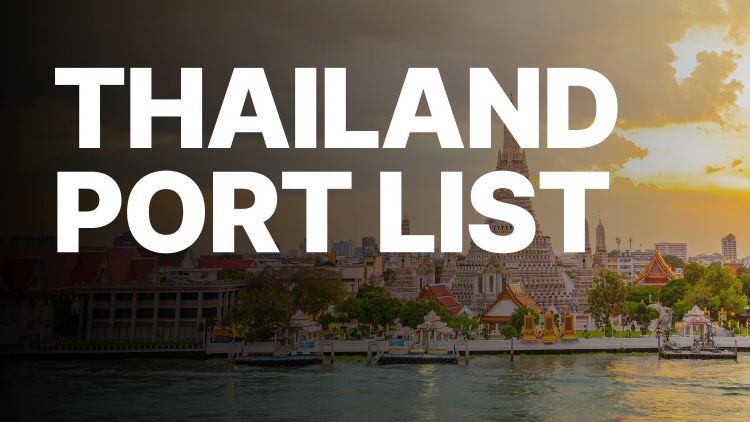
Thailand, strategically located in the heart of Southeast Asia, boasts a network of ports that are vital for connecting regional and global trade routes. These ports handle over 8 million TEUs annually and play a critical role in facilitating Thailand’s exports and imports, particularly in industries such as electronics, automotive, and agriculture. Managed by the Port Authority of Thailand (PAT), Thailand’s ports are undergoing significant modernization to enhance their capacity and efficiency.
Here’s an overview of Thailand’s major ports ranked by significance and cargo throughput:
1. Laem Chabang Port: Thailand’s Largest and Busiest Port

Key Features:
- Location: Chonburi Province, Gulf of Thailand
- Annual Throughput: Over 7 million TEUs (2024) | Total Cargo: ~54% of Thailand’s imports/exports
- Significance:
- Largest port in Thailand; ranked among the top 20 container ports globally.
- Serves as a major transshipment hub connecting Southeast Asia to Europe, China, and the Americas.
- Key industries served: automotive exports, electronics manufacturing, and agricultural products.
- Recent Developments:
- Phase 3 expansion underway to increase capacity to 18 million TEUs annually by 2030.
- Integration of green port initiatives including renewable energy solutions.
2. Bangkok Port (Klong Toey): Central Logistics Hub

Key Features:
- Location: Bangkok, Chao Phraya River
- Annual Throughput: Approximately 1.5 million TEUs (2024) | Cargo Volume: ~20 million tonnes
- Significance:
- Second-largest port in Thailand; serves as a key gateway for domestic and international cargo transportation.
- Handles containerized goods, RoRo cargo, and bulk freight; supports industries such as textiles and food processing.
- Recent Developments:
- Transformation into a smart port under the Klong Toey Smart Port initiative with advanced logistics technologies.
- Development of Bangkok Logistics Park to reduce national logistics costs by over THB 1 billion annually.
3. Ranong Port: Gateway to the Andaman Sea

Key Features:
- Location: Ranong Province, Andaman Sea Coast
- Annual Throughput: Approximately ~324,000 tonnes (2024) | Containers: ~2,796 TEUs
- Significance:
- Key port for trade with South Asia, Africa, Europe, and the Middle East; connects Thailand with Myanmar via maritime routes.
- Specializes in bulk cargo such as cement exports and animal feed imports.
- Recent Developments:
- Expansion of container yards and multipurpose piers to accommodate increased import-export volumes.
4. Songkhla Port: Southern Trade Hub

Key Features:
- Location: Songkhla Province, Gulf of Thailand Coast
- Annual Throughput: Approximately ~1 million tonnes (2024) | Multipurpose Cargo Handling
- Significance:
- Serves as a vital maritime hub for southern Thailand; handles bulk cargo (cement), general cargo, and containerized goods.
- Supports regional industries including agriculture and fisheries while boosting trade with Malaysia and Singapore.
- Recent Developments:
- Proposal for a cruise terminal to attract international tourism.
Economic Impact
Thailand’s ports are critical drivers of economic growth:
- Handle over 8 million TEUs annually, accounting for a significant portion of Southeast Asia’s trade volume.
- Contribute approximately THB 263 billion annually to GDP through port operations and logistics services.
- Ports like Laem Chabang facilitate trade worth billions annually by connecting key global markets.
Future Outlook
- Capacity Expansion Projects: Ports like Laem Chabang are undergoing significant expansions to handle growing trade volumes.
- Digitalization & Automation: Implementation of AI-based systems for real-time tracking and optimized cargo handling across major terminals.
- Green Shipping Initiatives: Ports like Bangkok are adopting renewable energy solutions such as solar-powered cranes to reduce carbon emissions.
- Regional Connectivity Enhancement: Investments in road networks connecting Ranong Port to inland industrial hubs aim to streamline logistics.
- Strategic Partnerships & Investments: Collaboration with global shipping lines like Maersk ensures continued growth in container throughput.
Thailand’s ports are more than just trade gateways—they are engines driving innovation, connectivity, and economic resilience across Southeast Asia and beyond. From Laem Chabang’s international dominance to Ranong’s emerging capabilities on the Andaman coast, each port plays a unique role in keeping Thailand at the forefront of global commerce while addressing future challenges with cutting-edge solutions.

Thailand’s Ports Explained: From Laem Chabang to Songkhla
What is the largest port in Thailand?
Laem Chabang Port is the largest and busiest port in Thailand. Located in Chonburi, it handles over 7 million TEUs annually, representing more than half of the nation’s container throughput. It plays a key role in automotive exports, electronics manufacturing, and serves as a major gateway to global markets.
How many TEUs do Thailand’s ports handle each year?
Thailand’s port network manages over 8 million TEUs annually, supporting critical supply chains in automotive, electronics, and agriculture. This volume continues to grow due to port expansions and increased trade with ASEAN and global partners.
What are the major seaports in Thailand?
The main seaports in Thailand include Laem Chabang Port, Bangkok Port (Klong Toey), Ranong Port, and Songkhla Port. Each serves different geographic regions and logistics functions—from containerized cargo to bulk and RoRo operations.
Why is Laem Chabang important for global logistics?
Laem Chabang is Thailand’s primary deep-sea port and a critical transshipment hub in Southeast Asia. It connects to global routes including China, Europe, and North America. Ongoing Phase 3 expansion aims to boost capacity to 18 million TEUs by 2030, enhancing Thailand’s competitiveness in maritime trade.
What upgrades are happening at Bangkok Port?
Bangkok Port is transitioning into a smart port through the Klong Toey Smart Port initiative. Upgrades include digital tracking systems, logistics automation, and the development of the Bangkok Logistics Park, which aims to cut logistics costs by over THB 1 billion annually.
Prefer email? Contact us directly at min.so@tradlinx.com (Americas), sondre.lyndon@tradlinx.com (Europe) or henry.jo@tradlinx.com (EMEA/Asia)


Leave a Reply