
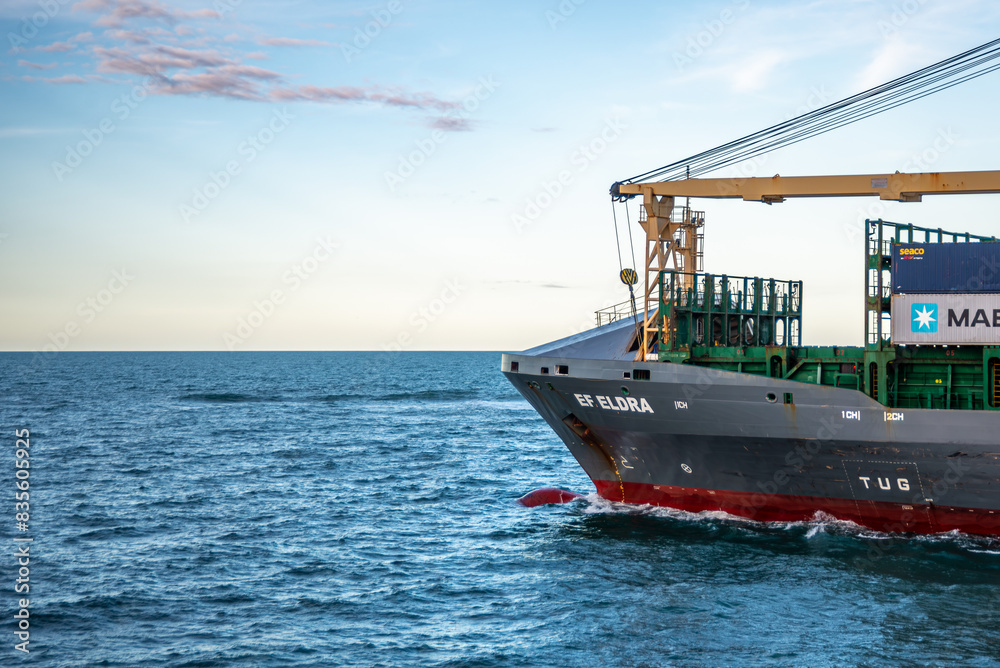
For December cargo to Brazil and the River Plate, the exposure sits below the booking. The service code on a booking confirmation is one carrier’s name for a loop that may be sold under several names, and several of these loops change port calls or partners within the same fortnight. A container can keep its booking number while the vessel, voyage or transshipment plan behind it changes.
What Each Carrier Has Announced
The table covers the five loops directly involved, with westbound calls as each carrier published them.
| Service name (carrier) | Operated or sold by | Status | Asia calls | South America calls |
|---|---|---|---|---|
| ASAS2 (Maersk) / SEAS3 (CMA CGM) | Maersk and CMA CGM | Ends. Last voyage 650W departs Shanghai 8 Dec 2026 | Shanghai, Hong Kong, Shekou, Singapore | Santos, Itajaí |
| SEAS 2 (CMA CGM) | CMA CGM | Revised rotation from 14 Dec 2026, CMA CGM COBALT from Tianjin Xingang | Tianjin Xingang, Qingdao, Shanghai, Ningbo, Shekou, Singapore | Rio de Janeiro, Santos, Paranaguá, Itapoá, Itajaí |
| SEAS A (CMA CGM) / TLA3 (OOCL) / ESA3 (COSCO) | Marketed under carrier-specific service names | From 17 Dec 2026, CMA CGM XENON from Ningbo | Ningbo, Shanghai, Shekou, Singapore | Santos, Navegantes, Montevideo, Buenos Aires. Coega on the return leg, subject to confirmation |
| AS3 (Hapag-Lloyd) / ZFS (ZIM) | Hapag-Lloyd and ZIM, vessel sharing agreement | Running since mid-September 2026 | Shanghai, Ningbo, Xiamen, Hong Kong, Yantian | Rio Grande, Paranaguá, Itajaí, Santos, Rio de Janeiro. River Plate via Rio Grande |
| ASAS (Maersk) | Maersk, described by Maersk as fully Maersk-operated | Continues | Not restated in Maersk’s December advisory | Not restated in Maersk’s December advisory |
One Loop Can Carry Several Service Names
CMA CGM’s revised SEAS A, OOCL’s TLA3 and COSCO’s ESA3 publish the same core westbound rotation: Ningbo, Shanghai, Shekou and Singapore, then Santos, Navegantes, Montevideo and Buenos Aires. The services begin in mid-December and represent the same underlying service string marketed under carrier-specific names.
The departing ASAS2 worked the same way, as Maersk’s name for a loop CMA CGM sold as SEAS3. AS3 and ZFS are Hapag-Lloyd’s and ZIM’s names for their shared loop.
This matters most when something goes wrong. An advisory about a blank sailing, an omitted call or a revised rotation can be issued under a partner’s service name, which a team watching only its own carrier’s code can miss. The stable reference across carriers is the container number. What needs monitoring against it is the current vessel and voyage assignment, connection status and shipment events.
Where Direct Calls Turn Into Connections
The AS3/ZFS loop shows how far a rotation can move between announcement and first sailing. When ZIM first announced ZFS, it was an independent service calling directly at Navegantes, Montevideo and Buenos Aires. The loop that launched in September as a Hapag-Lloyd and ZIM vessel sharing service calls Rio Grande, Paranaguá, Itajaí, Santos and Rio de Janeiro instead, and Hapag-Lloyd describes its River Plate coverage as running via Rio Grande. A Buenos Aires shipment planned against the original announcement therefore gained a transshipment leg that was not part of the initial published rotation.
December raises the same question at specific ports:
- Shekou loses its ASAS2 call. SEAS 2 and SEAS A/TLA3/ESA3 both load there.
- Itajaí loses its ASAS2 call. SEAS 2 and AS3/ZFS both discharge there.
- Navegantes appears on SEAS A/TLA3/ESA3 and not on the new SEAS 2 rotation.
- Montevideo and Buenos Aires are direct calls on SEAS A/TLA3/ESA3 and connections via Rio Grande on AS3/ZFS.
Each relay adds another vessel movement and a connection window at the hub. If that connection changes or is missed, the downstream ETA can move even while the original booking remains active. For operations teams, the relevant dates are therefore the container’s latest vessel assignment, connection status and revised destination ETA rather than the booking-stage schedule alone.
If your team is rechecking December Asia–South America bookings vessel by vessel across carrier sites, walk through how ops teams track container-level vessel changes and revised ETAs across carriers.

The 8 to 17 December Handover
The final ASAS2 voyage, 650W, departs Shanghai on 8 December. SEAS 2 begins its revised rotation from Tianjin Xingang on 14 December with the CMA CGM COBALT, and SEAS A from Ningbo on 17 December with the CMA CGM XENON. Cargo that misses voyage 650W, or sits on a later ASAS2 booking, will need a new vessel or routing assignment.
Maersk says customers can keep booking without interruption through ASAS, which it describes as fully Maersk-operated. The advisory does not say how ASAS2’s Shekou and Itajaí calls will be covered, so Maersk shippers using those ports should confirm the routing before December cut-offs.
One analyst expects capacity to tighten as the services are reshuffled. Solvens Advisory, in analysis published by The Loadstar, estimates that nominal weekly capacity from Asia could fall by about 4% under its expected post-restructuring configuration. The estimate depends partly on assumptions about how capacity is redeployed and should therefore be treated as an analyst scenario rather than a confirmed carrier figure. The same analysis notes that Maersk will operate a single loop without an in-house alternative if a sailing is blanked.
What to Check on December Bookings
- Open bookings that name ASAS2 or SEAS3 for any departure after voyage 650W, and the vessel and voyage each one is now assigned to
- Whether each discharge port is a direct call on the new rotation or a connection, especially Itajaí, Navegantes and the River Plate
- The partner service names for your loop, so advisories issued under those names reach your team
- The latest destination ETA after the container is loaded, compared with the booking-stage schedule
- Free-time and inland transport plans for shipments whose discharge port, connection or call order changes
Further Reading
- Service Update: Asia – East Coast South America Network (ASAS2), Maersk advisory as published by DataPortuaria
- ASAS2 Service Enhancement Asia ECSA, Maersk
- CMA CGM SEAS loops: enhanced direct services from the Far East to East Coast South America, AJOT
- CMA CGM revamps SEAS services, Container News
- COSCO Shipping launches new Far East–ECSA service, Container News
- OOCL to launch China–South America east coast service in December, AJOT
- Shipping from Asia to South America East Coast? Here’s our new AS3 service, Hapag-Lloyd
- Carrier service update (12 – 25 September 2026), Kuehne+Nagel
- ZIM launches new Falcon Service connecting Asia and the East Coast of South America, Shipping Herald
- Shippers urged to check routings as alliances redraw Asia–S America trade, The Loadstar
Service names, rotations and dates are as published by Maersk (ASAS2 advisory, early October 2026, as reproduced by DataPortuaria; ASAS2 rotation per Maersk’s December 2025 advisory), CMA CGM (SEAS 2 and SEAS A announcement, 30 September 2026, as published by AJOT), OOCL (TLA3, as reported by AJOT on 2 October 2026), COSCO (ESA3, as reported in October 2026) and Hapag-Lloyd (AS3 announcement, August 2026; rotation per Kuehne+Nagel’s September 2026 carrier update). The SEAS A Coega call is subject to carrier confirmation. The capacity estimate is an analyst scenario, not a carrier figure. Confirm vessel, voyage and port calls against your carrier’s current schedule before booking.
Need help interpreting this disruption or your shipment?
For a quick question, chat with Tradlinx on WhatsApp. For a deeper discussion, book a time below.
Prefer email? Contact us directly at min.so@tradlinx.com (Americas), sondre.lyndon@tradlinx.com (Europe), or henry.jo@tradlinx.com (EMEA/Asia).
Maersk and CMA CGM are ending their joint ASAS2/SEAS3 service between Asia and the East Coast of South America, with the last voyage, 650W, departing Shanghai on 8 December 2026. CMA CGM launches revised SEAS 2 and SEAS A rotations on 14 and 17 December. Hapag-Lloyd and ZIM have run a new shared loop since mid-September.
For December cargo to Brazil and the River Plate, the exposure sits below the booking. The service code on a booking confirmation is one carrier’s name for a loop that may be sold under several names, and several of these loops change port calls or partners within the same fortnight. A container can keep its booking number while the vessel, voyage or transshipment plan behind it changes.
What Each Carrier Has Announced
The table covers the five loops directly involved, with westbound calls as each carrier published them.
| Service name (carrier) | Operated or sold by | Status | Asia calls | South America calls |
|---|---|---|---|---|
| ASAS2 (Maersk) / SEAS3 (CMA CGM) | Maersk and CMA CGM | Ends. Last voyage 650W departs Shanghai 8 Dec 2026 | Shanghai, Hong Kong, Shekou, Singapore | Santos, Itajaí |
| SEAS 2 (CMA CGM) | CMA CGM | Revised rotation from 14 Dec 2026, CMA CGM COBALT from Tianjin Xingang | Tianjin Xingang, Qingdao, Shanghai, Ningbo, Shekou, Singapore | Rio de Janeiro, Santos, Paranaguá, Itapoá, Itajaí |
| SEAS A (CMA CGM) / TLA3 (OOCL) / ESA3 (COSCO) | Marketed under carrier-specific service names | From 17 Dec 2026, CMA CGM XENON from Ningbo | Ningbo, Shanghai, Shekou, Singapore | Santos, Navegantes, Montevideo, Buenos Aires. Coega on the return leg, subject to confirmation |
| AS3 (Hapag-Lloyd) / ZFS (ZIM) | Hapag-Lloyd and ZIM, vessel sharing agreement | Running since mid-September 2026 | Shanghai, Ningbo, Xiamen, Hong Kong, Yantian | Rio Grande, Paranaguá, Itajaí, Santos, Rio de Janeiro. River Plate via Rio Grande |
| ASAS (Maersk) | Maersk, described by Maersk as fully Maersk-operated | Continues | Not restated in Maersk’s December advisory | Not restated in Maersk’s December advisory |
One Loop Can Carry Several Service Names
CMA CGM’s revised SEAS A, OOCL’s TLA3 and COSCO’s ESA3 publish the same core westbound rotation: Ningbo, Shanghai, Shekou and Singapore, then Santos, Navegantes, Montevideo and Buenos Aires. The services begin in mid-December and represent the same underlying service string marketed under carrier-specific names.
The departing ASAS2 worked the same way, as Maersk’s name for a loop CMA CGM sold as SEAS3. AS3 and ZFS are Hapag-Lloyd’s and ZIM’s names for their shared loop.
This matters most when something goes wrong. An advisory about a blank sailing, an omitted call or a revised rotation can be issued under a partner’s service name, which a team watching only its own carrier’s code can miss. The stable reference across carriers is the container number. What needs monitoring against it is the current vessel and voyage assignment, connection status and shipment events.
Where Direct Calls Turn Into Connections
The AS3/ZFS loop shows how far a rotation can move between announcement and first sailing. When ZIM first announced ZFS, it was an independent service calling directly at Navegantes, Montevideo and Buenos Aires. The loop that launched in September as a Hapag-Lloyd and ZIM vessel sharing service calls Rio Grande, Paranaguá, Itajaí, Santos and Rio de Janeiro instead, and Hapag-Lloyd describes its River Plate coverage as running via Rio Grande. A Buenos Aires shipment planned against the original announcement therefore gained a transshipment leg that was not part of the initial published rotation.
December raises the same question at specific ports:
- Shekou loses its ASAS2 call. SEAS 2 and SEAS A/TLA3/ESA3 both load there.
- Itajaí loses its ASAS2 call. SEAS 2 and AS3/ZFS both discharge there.
- Navegantes appears on SEAS A/TLA3/ESA3 and not on the new SEAS 2 rotation.
- Montevideo and Buenos Aires are direct calls on SEAS A/TLA3/ESA3 and connections via Rio Grande on AS3/ZFS.
Each relay adds another vessel movement and a connection window at the hub. If that connection changes or is missed, the downstream ETA can move even while the original booking remains active. For operations teams, the relevant dates are therefore the container’s latest vessel assignment, connection status and revised destination ETA rather than the booking-stage schedule alone.
If your team is rechecking December Asia–South America bookings vessel by vessel across carrier sites, walk through how ops teams track container-level vessel changes and revised ETAs across carriers.
The 8 to 17 December Handover
The final ASAS2 voyage, 650W, departs Shanghai on 8 December. SEAS 2 begins its revised rotation from Tianjin Xingang on 14 December with the CMA CGM COBALT, and SEAS A from Ningbo on 17 December with the CMA CGM XENON. Cargo that misses voyage 650W, or sits on a later ASAS2 booking, will need a new vessel or routing assignment.
Maersk says customers can keep booking without interruption through ASAS, which it describes as fully Maersk-operated. The advisory does not say how ASAS2’s Shekou and Itajaí calls will be covered, so Maersk shippers using those ports should confirm the routing before December cut-offs.
One analyst expects capacity to tighten as the services are reshuffled. Solvens Advisory, in analysis published by The Loadstar, estimates that nominal weekly capacity from Asia could fall by about 4% under its expected post-restructuring configuration. The estimate depends partly on assumptions about how capacity is redeployed and should therefore be treated as an analyst scenario rather than a confirmed carrier figure. The same analysis notes that Maersk will operate a single loop without an in-house alternative if a sailing is blanked.
What to Check on December Bookings
- Open bookings that name ASAS2 or SEAS3 for any departure after voyage 650W, and the vessel and voyage each one is now assigned to
- Whether each discharge port is a direct call on the new rotation or a connection, especially Itajaí, Navegantes and the River Plate
- The partner service names for your loop, so advisories issued under those names reach your team
- The latest destination ETA after the container is loaded, compared with the booking-stage schedule
- Free-time and inland transport plans for shipments whose discharge port, connection or call order changes
Further Reading
- Service Update: Asia – East Coast South America Network (ASAS2), Maersk advisory as published by DataPortuaria
- ASAS2 Service Enhancement Asia ECSA, Maersk
- CMA CGM SEAS loops: enhanced direct services from the Far East to East Coast South America, AJOT
- CMA CGM revamps SEAS services, Container News
- COSCO Shipping launches new Far East–ECSA service, Container News
- OOCL to launch China–South America east coast service in December, AJOT
- Shipping from Asia to South America East Coast? Here’s our new AS3 service, Hapag-Lloyd
- Carrier service update (12 – 25 September 2026), Kuehne+Nagel
- ZIM launches new Falcon Service connecting Asia and the East Coast of South America, Shipping Herald
- Shippers urged to check routings as alliances redraw Asia–S America trade, The Loadstar
Service names, rotations and dates are as published by Maersk (ASAS2 advisory, early October 2026, as reproduced by DataPortuaria; ASAS2 rotation per Maersk’s December 2025 advisory), CMA CGM (SEAS 2 and SEAS A announcement, 30 September 2026, as published by AJOT), OOCL (TLA3, as reported by AJOT on 2 October 2026), COSCO (ESA3, as reported in October 2026) and Hapag-Lloyd (AS3 announcement, August 2026; rotation per Kuehne+Nagel’s September 2026 carrier update). The SEAS A Coega call is subject to carrier confirmation. The capacity estimate is an analyst scenario, not a carrier figure. Confirm vessel, voyage and port calls against your carrier’s current schedule before booking.
Need help interpreting this disruption or your shipment?
For a quick question, chat with Tradlinx on WhatsApp. For a deeper discussion, book a time below.
Prefer email? Contact us directly at min.so@tradlinx.com (Americas), sondre.lyndon@tradlinx.com (Europe), or henry.jo@tradlinx.com (EMEA/Asia).



Leave a Reply