

Xeneta’s chief analyst Peter Sand said on October 2 that Far East to US spot rates appear to have reached their post-Hormuz crisis peak for 2026, even after a small rise on October 1. Freightos’ September 30 weekly update pointed in the same direction, expecting demand to cool once Golden Week and the peak season are behind the market.
Through September, strong demand and congestion kept trans-Pacific space tight while rates climbed. As demand begins to ease, carriers are increasingly using blank sailings and allocation controls to manage effective capacity. Freightos reports more blanked sailings over the holiday period and into late October, alongside tighter allocations for some contracted forwarders.
For importers and forwarders with cargo moving in late October and November, that puts the booking itself at risk of changing through a blanked vessel, reduced allocation or rolled container.
Where Trans-Pacific Rates Stand in Early October
The main benchmarks still show rates close to their highs. They differ in method and timing, so each is best read against its own history.
| Benchmark | Lane | Latest reading | Change |
|---|---|---|---|
| Xeneta (Oct 1) | Far East to US West Coast | $8,346/FEU | +1.4% on the week |
| Xeneta (Oct 1) | Far East to US East Coast | $11,523/FEU | +0.7% on the week |
| Freightos (Sep 30 update) | Asia to US West Coast | About $8,400/FEU | New high for 2026 |
| Freightos (Sep 30 update) | Asia to US East Coast | About $9,600/FEU | About $200 below its late-August peak |
Trans-Pacific spot rate readings, early October 2026. Sources: Xeneta Weekly Ocean Container Shipping Market Update (October 2, data for October 1); Freightos weekly update (September 30).
Xeneta puts both US coasts 344% and 335% above their February 28 levels, the last reading before the Hormuz crisis. Sand attributes the turn partly to Asian port congestion easing as typhoon season winds down, with Golden Week holidays in China reducing exports in the first week of October.
Freightos recorded a new 2026 high on the West Coast, while its East Coast price sat about $200 below the late-August peak. On the Shanghai Containerized Freight Index, ICIS reported a 0.65% fall, the second weekly decline after eight straight weeks of increases.
Asia-Europe turned first. According to Xeneta, Far East to North Europe and Mediterranean rates have been falling since the start of July and kept falling into October.
How Far Rates Are Expected to Fall
Xeneta’s three-month outlook puts US East Coast spot rates at $6,000 to $7,000 per FEU and West Coast rates at around $4,500 to $5,500. Sand describes that as a sizeable correction that stops short of a collapse, and adds that a further major disruption could change the picture again.
The US East Coast is expected to fall harder because it starts higher. The spread between the two coasts is now $3,177 per FEU, against about $772 before the crisis, and Xeneta expects it to narrow as the decline takes hold.
Freightos expects the floor to stay high. Its update cites Sea-Intelligence estimates that port congestion is tying up more than 8% of global capacity and could take up to ten months to fully unwind. Combined with higher fuel costs since the Hormuz closure, Freightos sees that keeping rates elevated through low-demand weeks and setting a higher baseline when demand builds again ahead of Lunar New Year.
One policy variable also moved. Following a Trump-Xi meeting in late September, the US and China extended their trade truce by two months beyond its November 10 expiry. The White House also announced plans for more favorable tariff treatment covering about $30 billion of imports on each side, subject to each country’s domestic legal procedures.
Freightos expects the de-escalation to postpone US port fees on China-linked vessels. At the time of its update, however, the USTR had not formally extended the existing suspension, so the fee postponement remained an expectation rather than confirmed policy.
How Carriers Defend a Falling Market
Freightos reports that carriers have added blanked sailings over the holiday period and into late October. It also links Far East congestion, which drains usable capacity, to some carriers reducing allocations for contracted forwarders.
Both moves hit the booking. A blanked sailing shifts cargo onto a later vessel, which may also be absorbing boxes rolled from the cancelled voyage. A reduced allocation can leave a forwarder holding contract rates with part of its weekly volume to place elsewhere or hold back.
For the cargo owner, either outcome can arrive as an ETD that moves after the shipment has already been planned around it.
Cargo booked around Golden Week and the first post-holiday departures deserves particular attention because carriers are thinning schedules at the same time that delayed and rolled cargo is still moving through the network.
If your team is learning about blanked sailings and rolled bookings only after the ETD has moved, see how ops teams track sailing and vessel changes across carriers before cargo misses its window.

Origin Congestion Is Easing Unevenly
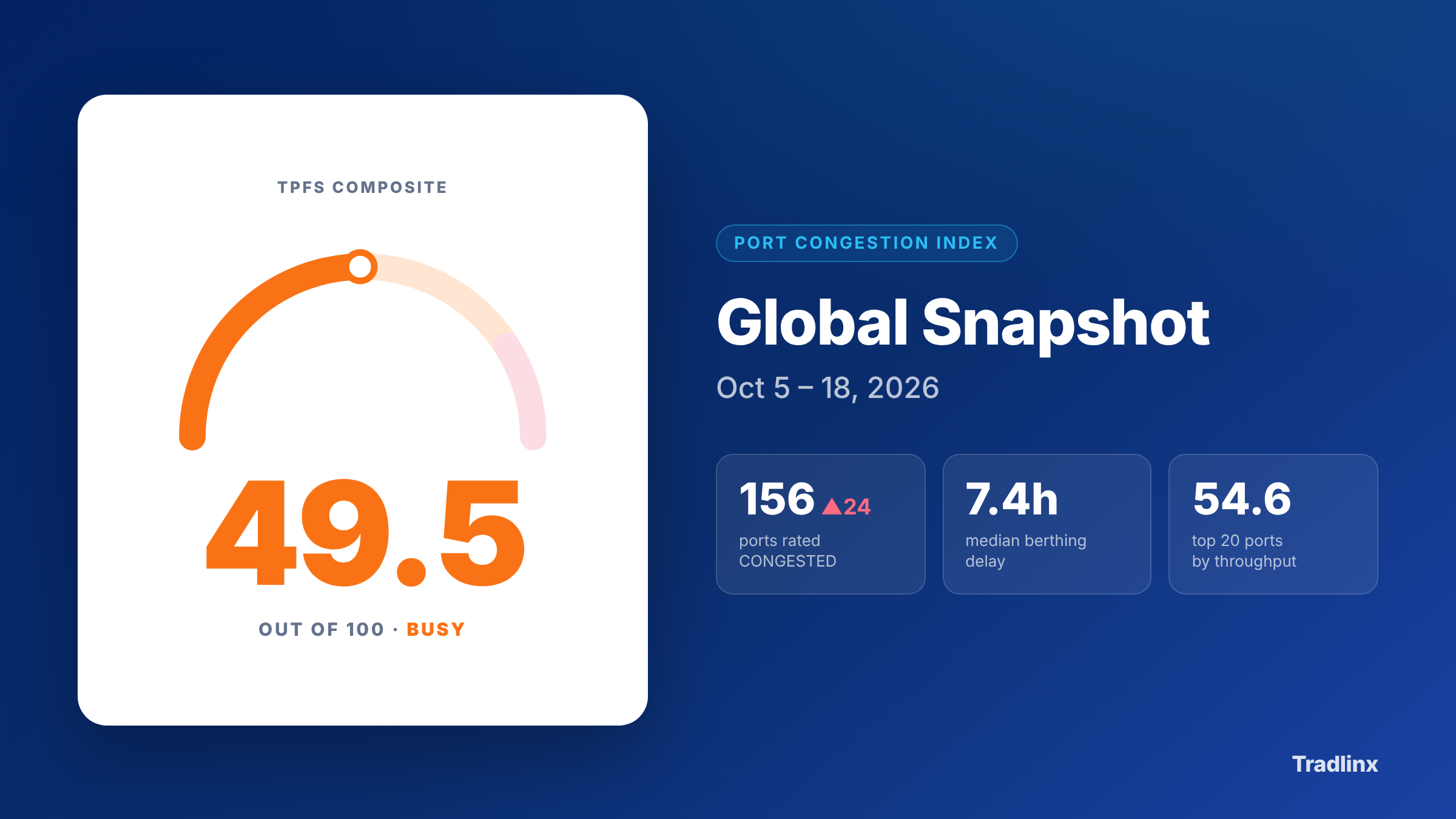
The easing Xeneta describes was already visible in Tradlinx port data through September 20, but conditions differed by gateway.
South China ports were generally clearing. Shanghai, however, was still worsening in the latest three-day window, with average pre-berth waiting time at 12.2 hours compared with 8.8 hours over two weeks. Ningbo remained elevated compared with the previous two-week period, although its shorter-window reading had begun to ease.
Schedule reliability deteriorated further in August. Sea-Intelligence put Asia-wide vessel schedule reliability at just 32.3%, while Shanghai fell to 12.2% and Ningbo to 16.9%. Global schedule reliability dropped to 49.9%, its lowest level since September 2022.
A falling rate and a recovering schedule run on separate clocks. Plans that read the rate turn as evidence that sailings are already back to normal risk missing late-October blanks and origin delays that are still clearing.
What to Re-Check on Q4 Trans-Pacific Cargo
- Late-October sailings: Check each booked vessel and voyage against the carrier’s current blank-sailing notices, and get any replacement sailing confirmed in writing.
- Forwarder allocations: Confirm October and November weekly allocations with each carrier now, and agree in advance where overflow volume goes if an allocation is cut.
- Shanghai and Ningbo loads: Treat current port congestion as a schedule-risk indicator, then confirm the booked vessel’s latest ETD, terminal status and voyage changes with the carrier or forwarder.
- East Coast cargo: Build a review date into spot quotes that run into November, since Xeneta’s forecast points to East Coast rates falling faster than West Coast rates.
- Q4 freight budgets: Use Xeneta’s three-month ranges as a year-end reference scenario rather than an assumed Q4 average. Near-term rates remain substantially higher.
- Lunar New Year bookings: Freightos expects rates to rise from a higher baseline when demand builds ahead of the holiday. Factor that expected rebound into January planning and confirm carrier booking windows before peak-season space tightens.
Further Reading
- Xeneta Weekly Ocean Container Shipping Market Update, 2 October 2026
- Freightos Weekly Update: China-US truce to reduce some tariffs, and likely postpone port fees
- Asia-US container rates rise, could be at peak — ICIS via Hellenic Shipping News
- Sea-Intelligence: Sharp reliability drop from Asian port congestion
- Tradlinx Port Congestion Index: Sep 7 to 20, 2026 interactive report
Rate figures are spot index readings: Xeneta market average spot rates for October 1, 2026, and Freightos Baltic Index readings reported in Freightos’ September 30, 2026 weekly update. The indices use different methods and are not directly comparable. The three-month rate ranges are Xeneta’s forecast. The SCFI movement is as reported by ICIS. Port wait figures are from the Tradlinx Port Congestion Index (Sep 7 to 20, 2026 edition), with data as of September 20, 2026. Schedule reliability figures are from Sea-Intelligence’s Global Liner Performance data for August 2026. Confirm sailings, allocations and rates against your own carrier bookings and contracts.
Need help interpreting this disruption or your shipment?
For a quick question, chat with Tradlinx on WhatsApp. For a deeper discussion, book a time below.
Prefer email? Contact us directly at min.so@tradlinx.com (Americas), sondre.lyndon@tradlinx.com (Europe), or henry.jo@tradlinx.com (EMEA/Asia).



Leave a Reply