
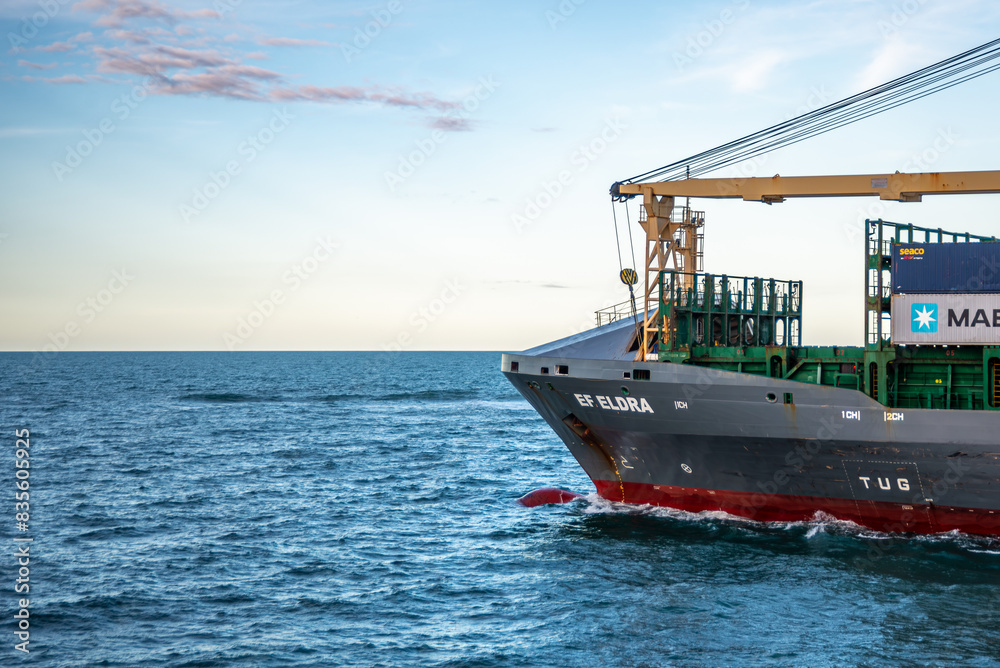
Maersk and Hapag-Lloyd are moving four more Gemini Cooperation services from the Cape of Good Hope to the Suez Canal, starting with a westbound sailing from Tanjung Pelepas on 19 September. The partners sell the same loops under different names. Maersk’s AE5, AE11, AE12 and ME2 are Hapag-Lloyd’s NE4, SE2, SE1 and IEX.
Teams holding bookings with both carriers have to translate those codes before counting their Suez exposure, and the shorter routing adds a timing problem on top. A Suez sailing can reach Europe up to two weeks ahead of Cape vessels already at sea on the same loop, so containers can arrive in a different order from the one their trucking and warehouse slots were planned around.
What Changes on AE5, AE11, AE12 and ME2
Maersk’s advisory of 14 September moves all four services to the trans-Suez route in both directions. They join AE15 and AE19, the two Gemini services already routing through the canal.
| Maersk service | Hapag-Lloyd service | Trade | Rotation as published |
|---|---|---|---|
| AE5 | NE4 | Asia to North Europe | Qingdao – Ningbo – Tanjung Pelepas – Suez Canal – London – Bremerhaven – Hamburg – Rotterdam – Algeciras – Suez Canal – Tanjung Pelepas |
| AE11 | SE2 | Asia to Mediterranean | Shanghai – Yantian – Tanjung Pelepas – Suez Canal – Port Tangier – Valencia – Barcelona – La Spezia – Genoa – Vado Ligure – Suez Canal – Singapore |
| AE12 | SE1 | Asia to Mediterranean | Ningbo – Shanghai – Tanjung Pelepas – Suez Canal – Algeciras – Koper – Rijeka – Algeciras – Suez Canal – Singapore |
| ME2 | IEX | India to Europe | Ennore – Colombo – Suez Canal – Algeciras – Rotterdam – London – Hamburg – Port Tangier – Suez Canal – Colombo |
Both carriers make the change conditional on continued stability in the Red Sea and no further escalation in the region. Hapag-Lloyd told Seatrade Maritime News that Suez transits remain limited across its network, with most of its services still sailing around the Cape. A Hapag-Lloyd booking portfolio can therefore hold both routings at once.
First Sailings Start on Different Dates by Direction
The carrier advisories name the first vessel to take the Suez routing on each service and direction.
| Service (Maersk / Hapag-Lloyd) | Direction | First vessel and voyage | Last call | ETD |
|---|---|---|---|---|
| AE11 / SE2 | Westbound | Antonia Maersk 635W | Tanjung Pelepas | 19 Sep 2026 |
| AE5 / NE4 | Westbound | Marchen Maersk 635W | Tanjung Pelepas | 21 Sep 2026 |
| ME2 / IEX | Westbound | Cornelia Maersk 638W | Colombo | 24 Sep 2026 (Maersk); 19 Sep 2026 (Hapag-Lloyd) |
| AE5 / NE4 | Eastbound | Maastricht Maersk 637E | Algeciras | 22 Sep 2026 |
| AE11 / SE2 | Eastbound | Maersk Halifax 637E | Vado Ligure | 28 Sep 2026 |
| ME2 / IEX | Eastbound | Cornelia Maersk 643E | Port Tangier | 31 Oct 2026 |
| AE12 / SE1 | Both | To be announced | To be announced | To be announced |
The westbound switches begin in the second half of September. Eastbound, the first published Suez sailings run from 22 September to 31 October, and ME2/IEX carries the widest directional gap. Its first eastbound Suez sailing is Cornelia Maersk 643E from Port Tangier on 31 October.
For the first westbound ME2/IEX sailing, the carriers currently publish different dates for the same Cornelia Maersk 638W voyage. Maersk lists 24 September from Colombo, while Hapag-Lloyd lists 19 September. Confirm the live vessel schedule against the booking before planning around either date.
AE12, sold by Hapag-Lloyd as SE1, has no first Suez sailing in either direction yet. Until one is published, plan that loop on Cape transit times.
Why Containers Can Arrive Out of Sailing Order
The transit-time gain is what creates the exposure. Xeneta, cited by Seatrade Maritime News on 10 September, put the average Yantian to Rotterdam sailing time at 41 days across nine services routed via the Cape. One vessel that transited Bab el-Mandeb and Suez made the same trip in 27 days.
Xeneta’s warning concerns the changeover period. When a string switches, the first Suez arrivals can land up to 14 days early while Cape vessels on the old schedule are still at sea, and ships bunch at the first port of discharge if that port is unchanged. On the rotations Maersk published, the first European call after Suez is London on AE5, Port Tangier on AE11 and Algeciras on both AE12 and ME2.
Carriers can spread the load by moving the first discharge call, as Maersk did on AE19 when it switched the first call from Tanger Med to Port Said. Xeneta chief analyst Peter Sand told the publication this cannot be done on every service, because services are planned around key hubs.
For a cargo owner, the result is that a container can be discharged ahead of cargo that sailed before it on the same loop. Trucking appointments and warehouse receiving slots set against the original ETA fall out of step. Where free time runs from discharge, the clock on an early container also starts sooner than planned.
The code split makes this harder to see across a portfolio. A forwarder with AE11 bookings through Maersk and SE2 bookings through Hapag-Lloyd has cargo on the same vessels, yet a shipment report grouped by service name shows two loops. Grouping by vessel and voyage, then reading each container’s current ETA, shows which boxes now run on the Suez timetable.
If your team is matching Maersk and Hapag-Lloyd bookings to Gemini vessels by hand to work out which containers now run on Suez timings, walk through how ops teams follow vessel and ETA changes at container level across carriers.

A Conditional Return During a Houthi Advance
The announcement came as Houthi forces extended their position along Yemen’s Red Sea coast and around Bab el-Mandeb. James Hookham, director of the Global Shippers’ Forum, told Seatrade Maritime News he was shocked by the timing and questioned whether the carriers had received any assurance from the Houthis that the ships would not be attacked.
Shippers’ concern covers cost as well as crew safety, since a second diversion back around the Cape would bring its own disruption. Maersk has already reversed a broader Red Sea return once this year. It said it suspended Red Sea services on 1 March, the day after the US and Israeli attacks on Iran, and has conducted a limited number of Red Sea sailings since 31 May.
We laid out the watch list for that reversal clause when AE15 made the same move in July, in AE15 Went Back to Suez the Day After a Red Sea Attack. The four services switching now carry the same condition.
What to Re-Check This Week
- Translate every open Gemini booking to its pair (AE5/NE4, AE11/SE2, AE12/SE1, ME2/IEX) before counting Suez exposure across Maersk and Hapag-Lloyd.
- Group bookings by vessel and voyage, and flag any container on the first Suez sailings listed above.
- Re-pull the ETA for containers on those sailings and on Cape sailings of the same loops already at sea. Do not assume the original arrival order holds.
- For cargo discharging at London, Port Tangier or Algeciras, watch berth waits in the weeks the first Suez sailings arrive.
- Where free time runs from discharge, recalculate the last free day from the revised discharge date.
- For Europe to India cargo on ME2/IEX, plan on Cape transit times until the 31 October sailing from Port Tangier.
- Keep AE12/SE1 bookings on Cape transit times until a first Suez sailing is published.
- Hold a Cape-routing fallback in delivery plans. Both carriers tie the switch to no further escalation in the region.
Further Reading
- Maersk, Structural changes to AE5, AE11, AE12 and ME2 Gemini services (14 September 2026)
- Hapag-Lloyd, Routing update for our NE4, SE1, SE2 and IEX services
- Splash247, Middle East shipping routes pull in opposite directions (15 September 2026)
- Seatrade Maritime News, Suez returns raise bunching fears (10 September 2026)
- Seatrade Maritime News, Shocked Gemini shippers seek Red Sea reassurance (15 September 2026)
- gCaptain, Maersk, Hapag-Lloyd Accelerate Return to Suez Despite Red Sea Risks (14 September 2026)
- Seatrade Maritime News, Gemini Suez return signals cautious step towards liner normalisation (8 July 2026)
Service codes, rotations, first vessels, voyages, last calls and ETDs are taken from Maersk’s advisory of 14 September 2026 and Hapag-Lloyd’s corresponding routing update. The carriers currently publish different dates for Cornelia Maersk 638W on ME2/IEX: Maersk lists 24 September from Colombo and Hapag-Lloyd lists 19 September. Sailing-time figures and the bunching assessment are Xeneta’s, as reported by Seatrade Maritime News on 10 September 2026, and the 27-day figure reflects one vessel. Security context and shipper comments are from Seatrade Maritime News (15 September 2026) and gCaptain (14 September 2026), and the 1 March suspension is from Seatrade Maritime News (8 July 2026). Routings are conditional and can change at short notice. Confirm vessel, voyage and ETA against your own booking before acting. Data as of 16 September 2026.
Need help interpreting this disruption or your shipment?
For a quick question, chat with Tradlinx on WhatsApp. For a deeper discussion, book a time below.
Prefer email? Contact us directly at min.so@tradlinx.com (Americas), sondre.lyndon@tradlinx.com (Europe), or henry.jo@tradlinx.com (EMEA/Asia).



Leave a Reply