
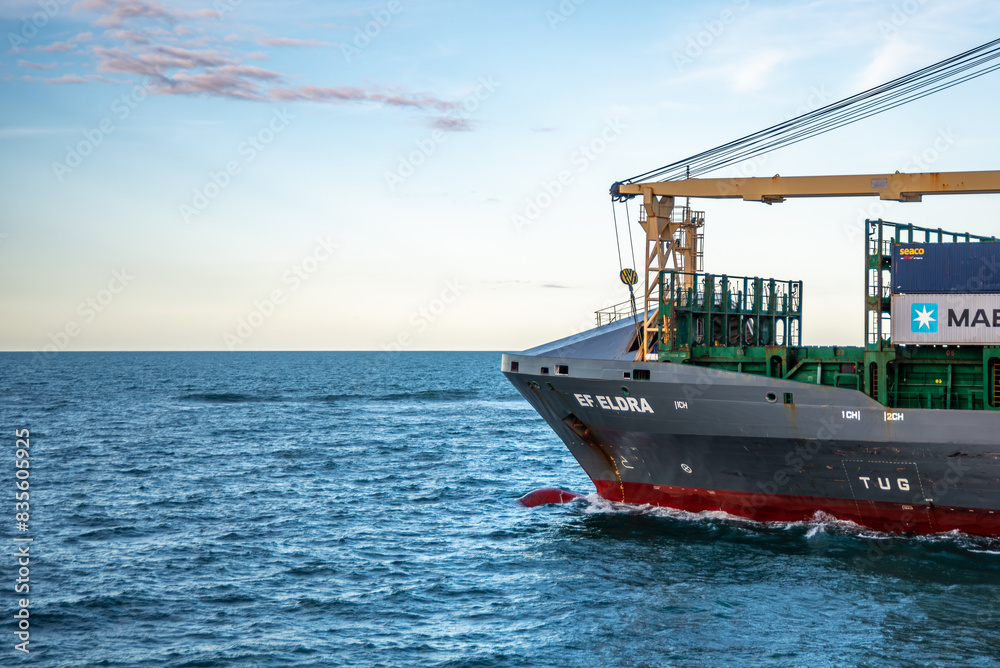
Maersk’s Gulf contingency arrangements can leave a container somewhere other than its discharge terminal. Khor Fakkan is relocating containers to ICD Sajaa, while Fujairah Terminal is shifting selected full containers bound for Jebel Ali to the Al Hayl off-dock yard. Both measures appeared in Maersk’s 26 October 2026 operational update and remain in its latest update, published on 12 November.
The newer cost development came on 6 November, when Maersk introduced Sajaa empty-container drop-off charges of USD 1,000 for a 20-foot container and USD 1,200 for a 40-foot or reefer under its limited-acceptance tariff. Shipments cleared at Sajaa must return their empties there.
If you collect or clear containers at either port, the discharge event alone no longer tells you where the box is or what it will cost to get it out. Maersk uses both Sajja and Sajaa for the inland depot; this article uses Sajaa throughout.
In September, we covered the earlier rerouting arrangements, when selected Khor Fakkan bookings began moving through Fujairah and onward to Jebel Ali, alongside changes to empty returns and D&D (Maersk’s Gulf Rerouting Now Changes Port of Discharge, D&D and Empty Returns). The October and November updates add what happens to the container after discharge.
Where a Maersk Gulf Container Can Go After Discharge
| Shipment | What Maersk says | What to confirm |
|---|---|---|
| Booked to CY Khor Fakkan | To ease congestion, the terminal is relocating containers to ICD Sajaa. This may affect collection arrangements. Maersk does not say every container is being moved. | Whether the container is still at Khor Fakkan or has been transferred to Sajaa, before dispatching a truck |
| Accepted dangerous-goods cargo via Khor Fakkan, consignee registered in Khor Fakkan or Sharjah | Under its DG booking guidance, Maersk says accepted cargo moves via Sajaa ICD. Registered customers can clear at Sajaa and pay the applicable GT charges directly. | DG acceptance conditions, clearance location and collection instructions |
| Accepted dangerous-goods cargo via Khor Fakkan, consignee not registered locally, delivery to Jebel Ali or Abu Dhabi | Maersk’s DG guidance allows a double-bonded movement from Khor Fakkan to Sajaa, then to Jebel Ali or Abu Dhabi, billed at haulage rates. | Whether the double-bonded movement has been requested and accepted, and the haulage rate |
| Selected CY Khor Fakkan bookings | The Final Port of Destination may change to Jebel Ali, either through discharge at Fujairah followed by bonded landside transport, or through direct discharge at Jebel Ali where the feeder can transit the Strait of Hormuz. | The revised destination and routing. Shipments on vessels transiting Hormuz carry an additional USD 1,000 per container. |
| Discharged at Fujairah, final place of delivery Jebel Ali | Because of yard density, Fujairah Terminal is shifting selected full laden containers to Al Hayl at its discretion. Affected customers will be notified. Shifting, handling and storage costs at Al Hayl are recoverable from the merchant. | Whether the container has moved to Al Hayl, its next bonded movement, and who carries the additional costs |
| Cleared at Sajaa Dry Port | Empties must be returned to Sajaa Dry Port. Maersk’s limited-acceptance drop-off table, effective 6 November 2026, lists USD 1,000 for a 20-foot container and USD 1,200 for a 40-foot or reefer. If the return location on a delivery order is not accepting empties at the time of return, Maersk issues an updated instruction to an available depot. | The return location on the delivery order, its acceptance status before the empty moves, and whether the charge is in your landed-cost estimate |
| Port of discharge or place of delivery in Saudi Arabia | Saudi cargo continues through Jeddah, including onward movements to Riyadh and Dammam on the Jeddah Landbridge. | Capacity, customs and border processing, and onward delivery for the individual shipment |
Why Khor Fakkan and Fujairah Are Moving Containers Inland
Maersk cites vessel congestion, limited berthing availability, high yard utilization, road congestion and extended truck waiting times at Khor Fakkan. At Fujairah Terminal, it cites operational constraints and yard density. Both ports sit on the Gulf of Oman, outside the Strait of Hormuz.
More direct volume is scheduled for Khor Fakkan. Maersk and Hapag-Lloyd have relaunched the FM1 service under the Gemini Cooperation on a Qingdao, Ningbo, Tanjung Pelepas, Khor Fakkan and Singapore rotation. Maersk’s 13 October announcement named Maersk Athabasca voyage 642W as the first sailing, scheduled to leave Qingdao on 17 October and reach Khor Fakkan on 16 November. That date comes from the original announcement, so check the current ETA. Maersk says its existing landside solutions will carry onward connections to the Upper Gulf.
For shipments on the direct-discharge route, Jebel Ali has also tightened. In Tradlinx’s Port Congestion Index for 19 October to 1 November 2026, Jebel Ali moved from STABLE to BUSY, with a berthing delay of 28.5 hours, up 18.6 hours from the previous two-week period. The reading for the final three days of that period was 32.3 hours.
Maersk’s Saudi Cargo Routing Continues Through Jeddah
Shipments with a port of discharge or place of delivery in Saudi Arabia continue to move through Jeddah, including cargo for Riyadh and Dammam on the Jeddah Landbridge. Maersk’s India, Middle East and Africa market update, published on 9 November, says use of the Saudi Landbridge increased in October as conditions at Khor Fakkan and disruption linked to the Strait of Hormuz led customers to explore alternative routes. Interest is expected to continue into November.
Maersk asks customers to check space, customs requirements, documentation and delivery feasibility early, and to confirm capacity, border processing and onward delivery for each shipment before routing decisions are final.
Jeddah does not work as a fallback for UAE-bound cargo. Maersk’s 12 November update still lists these landside bookings as temporarily paused:
- Cargo from the UAE and Qatar via Jeddah and Oman ports
- Cargo from Jeddah to the UAE, Oman and Qatar
- Cargo from Salalah and Sohar to the UAE, Saudi Arabia, Kuwait, Bahrain and Qatar
Cargo for Kuwait, Iraq, Qatar, Bahrain and the UAE that previously transshipped at Jeddah now transships via Salalah and Khor Fakkan, moves by landbridge to Sharjah, and connects to its final destination on Maersk’s intra-Gulf feeder network.
Where the Discharge Event Stops Being Enough
A delivery plan built on the discharge port assumes the container is waiting at that terminal. For affected shipments at Khor Fakkan and Fujairah, it may already be at Sajaa or Al Hayl, with another bonded move still ahead. Maersk says affected customers will be notified, but the discharge event alone does not show where the box is now.
The event to watch is the first one after discharge. A gate-out at Khor Fakkan or Fujairah that your own trucker did not make can be a terminal transfer to Sajaa or Al Hayl. Treat it as a location change until it matches a confirmed pickup, and check it against the latest notice from Maersk.
Maersk recovers the Al Hayl shifting, handling and storage charges from the merchant whenever the move happens. Catching the move early saves a wasted truck dispatch and gets the onward bonded movement arranged sooner.
If your team is matching post-discharge gate-outs against carrier notices by hand, walk through how ops teams flag container moves after discharge across carriers.

What to Re-Check This Week
- Khor Fakkan CY bookings: before dispatching a truck, ask Maersk whether the container is still at the terminal or has been relocated to Sajaa, and confirm the current collection location.
- Dangerous-goods cargo via Sajaa: check DG acceptance, consignee registration and clearance arrangements. For cargo moving on to Jebel Ali or Abu Dhabi, confirm the double-bonded movement through Sajaa is arranged and the haulage rate that applies.
- Final Port of Destination: check whether any open Khor Fakkan CY booking has been redirected to Jebel Ali, and whether it moves via Fujairah and bonded landside transport or by direct feeder.
- Fujairah discharges for Jebel Ali: watch for an Al Hayl relocation notice, and confirm the onward bonded movement and who carries the recoverable shifting, handling and storage charges.
- Empty returns after Sajaa clearance: check the return location on the delivery order and whether it is accepting empties before the container moves. Budget the Sajaa drop-off charge in effect from 6 November.
- Hormuz transit costs: for shipments moving by sea through the strait, Maersk adds USD 1,000 per container on top of the Emergency Freight rate. The fee replaces the separately charged landbridge costs for shipments on that sea routing.
- Saudi shipments via Jeddah: confirm capacity, customs and border requirements, and onward delivery for each landbridge movement, and check the paused routes before proposing an alternative.
- FM1 cargo: if you have containers on Maersk Athabasca voyage 642W, check the current Khor Fakkan ETA and run the collection checks above before arrival. Maersk originally scheduled the call for 16 November.
Further Reading
- Maersk, Middle East Operational Update 54 (12 November 2026)
- Maersk, Middle East Operational Update 53 (6 November 2026)
- Maersk, Middle East Operational Update 52 (26 October 2026)
- Maersk, India, Middle East and Africa Market Update (9 November 2026)
- Maersk, FM1 Service Relaunch on Gemini Network (13 October 2026)
- Tradlinx, Port Congestion Index: Global Snapshot, Oct 19 – Nov 1, 2026
Source note: the Khor Fakkan and Fujairah relocations appear in Maersk Middle East Operational Update 52 (26 October 2026) and remain in Updates 53 (6 November) and 54 (12 November). The Sajaa empty-return instruction and drop-off charge are from Update 53 and are retained in Update 54. The dangerous-goods clearance and double-bonded movement provisions are from Maersk’s DG booking guidance in the same updates. Saudi Landbridge trends are from Maersk’s 9 November regional market update. The FM1 rotation and originally announced first-sailing schedule are from Maersk’s 13 October announcement. Jebel Ali berthing delays are from the Tradlinx Port Congestion Index covering 19 October to 1 November 2026. Maersk states that its measures are subject to change. Confirm routing, charges, return instructions and schedules for each shipment against the latest advisory and your contract before acting.
Need help interpreting this disruption or your shipment?
For a quick question, chat with Tradlinx on WhatsApp. For a deeper discussion, book a time below.



Leave a Reply