
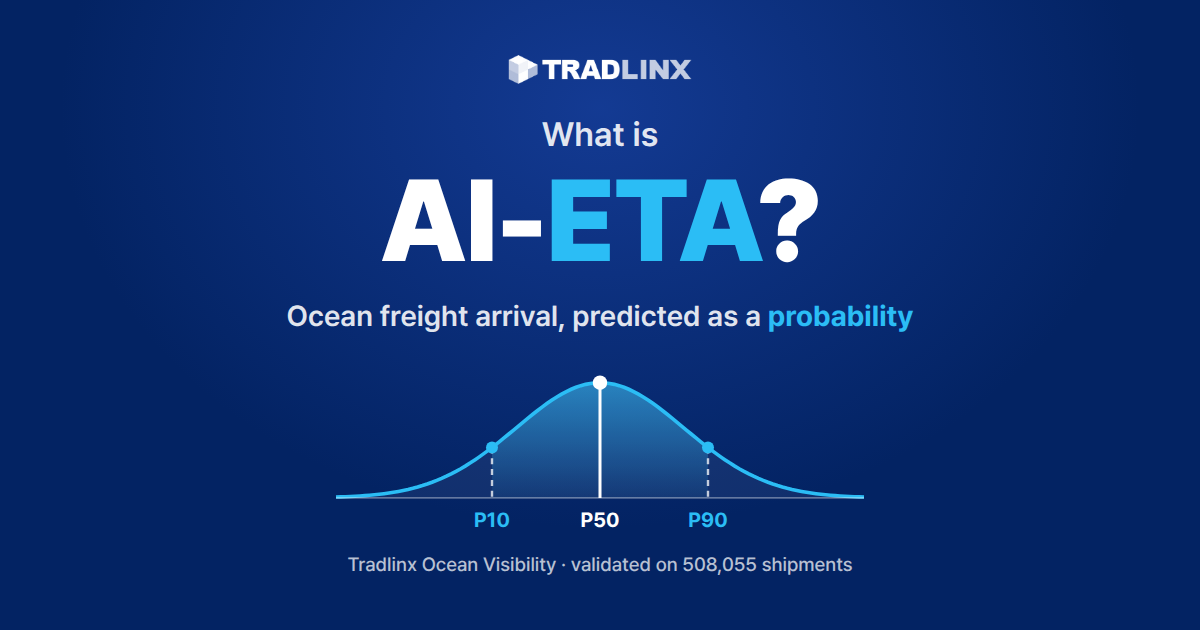
AI-ETA (AI ETA) is an arrival prediction for ocean freight that gives a range of likely arrival times and the probability of each, instead of a single date. It tells you when a shipment is likely to arrive and how confident that answer is, so planning teams know how much they can rely on it.
AI-ETA is part of Tradlinx Ocean Visibility. This article explains what it is, why carrier ETAs fall short, and how AI-ETA compared with carrier ETAs across 508,055 shipments.
Why carrier ETA is not enough
Most teams plan around the ETA the carrier provides. Three problems show up again and again.
1. There is only one number.
A carrier ETA is a single arrival time. It doesn’t tell you how firm that time is or how far it could move.
2. You don’t know when it will change.
Update timing varies widely by carrier. The same value can sit unchanged for days, then jump. Operators end up checking carrier portals by hand to see whether anything has moved.
3. On some legs, it is missing.
In a Tradlinx analysis of more than 500,000 shipments a year, the carrier ETA went blank at some point before arrival on 1 in 12 shipments (8.43%). 87% of those gaps involved transshipment cargo, and 72% happened at an intermediate transshipment port, where cargo moves from one vessel to the next.

When the ETA is a single, unpredictable, sometimes empty value, the cost shows up elsewhere:
- Demurrage and detention, when yard, truck and terminal bookings for the final 24 to 48 hours don’t match what actually happens
- Safety stock, when teams add a two- to three-day buffer to protect delivery dates
- Customer handling, when staff spend time on ETA change notices and renegotiating dates
How AI-ETA is different
AI-ETA treats arrival as a distribution, not a point. For every shipment it provides three arrival times and the probability behind them.
| Carrier ETA | AI-ETA | |
|---|---|---|
| Output | One arrival time | Three arrival scenarios + arrival probability |
| Confidence | Not shown | Shown as probability |
| Update timing | Irregular, varies by carrier | Every 2 to 4 hours, until arrival |
| Transshipment legs | Often blank | Predicted leg by leg and linked across vessels |
| Schedule conflicts | Passed through as reported | Detected and corrected |
Reading the three scenarios: P10, P50 and P90
AI-ETA expresses the arrival window with three points:
- P10, the early-arrival scenario. There is a 10% chance the shipment arrives by this time. Use it as the earliest point to open yard slots and book trucks.
- P50, the standard arrival time. The midpoint of the distribution. Use it for production and inbound scheduling.
- P90, the late-arrival scenario. There is a 90% chance the shipment arrives by this time. Use it for delivery dates you commit to customers and for the safety stock behind them.
The range between P10 and P90 covers roughly 80% of voyages, so operations teams can treat it as the realistic arrival window.
Fixing schedules that don’t add up
For transshipment cargo, an arrival estimate is a chain of dates: arrival at the transshipment port, then departure on the next vessel. Carrier-reported schedules sometimes break that order. In our data, we found 112 cases where the next leg’s departure was recorded earlier than the cargo’s actual arrival from the previous leg. In the most extreme case, the gap was 288 hours, about 12 days.
AI-ETA links transshipment legs together and corrects these time inversions, so the arrival estimate follows a sequence that can actually happen.
How accurate is AI-ETA?
Tradlinx compared AI-ETA with carrier ETAs on the same 508,055 shipments with arrival confirmed through March 2026, measuring how far each estimate was from the actual arrival at the same point in time.
- All shipments: the average gap from actual arrival was 15.4 hours for carrier ETA and 10.6 hours for AI-ETA, 31.4% lower.
- Shipments where the carrier ETA was off by 48 hours or more (25,341 shipments, 4.99%): the average gap was 90.0 hours for carrier ETA and 9.2 hours for AI-ETA.

The second figure matters most in practice. These are the shipments that cause missed bookings, idle production lines and difficult customer calls.
Percentages are calculated from unrounded values.
How it fits into existing systems
AI-ETA is delivered through an API. Teams point it at the ETA field their ERP or TMS already uses, and one timestamp becomes three arrival times plus a probability. No change in planning workflow is needed to start; the same field simply carries more information.
Frequently asked questions
Is AI-ETA the same as a predictive ETA?
Predictive ETA is the general term for estimating arrival with models instead of relying only on the carrier’s schedule. AI-ETA is Tradlinx’s approach within that category. Its main difference is that it gives a probability distribution rather than a single predicted date.
How often does AI-ETA update?
Every 2 to 4 hours, on the same cycle from departure to arrival. Carrier ETAs, by contrast, change only when the carrier’s system refreshes, and that timing varies by carrier.
Does AI-ETA work when the carrier ETA is missing?
Yes. Missing carrier ETAs occur most often on transshipment legs, and AI-ETA predicts each leg and links them across vessels.
Who uses AI-ETA?
Shippers use it to set delivery commitments, schedule production and inbound work, and size safety stock. Forwarders use it to spot exceptions early, monitor transshipment connections and keep customers informed with consistent arrival windows.
How do I get started?
AI-ETA is available in Tradlinx Ocean Visibility. See how AI-ETA works and request a demo →



Leave a Reply