
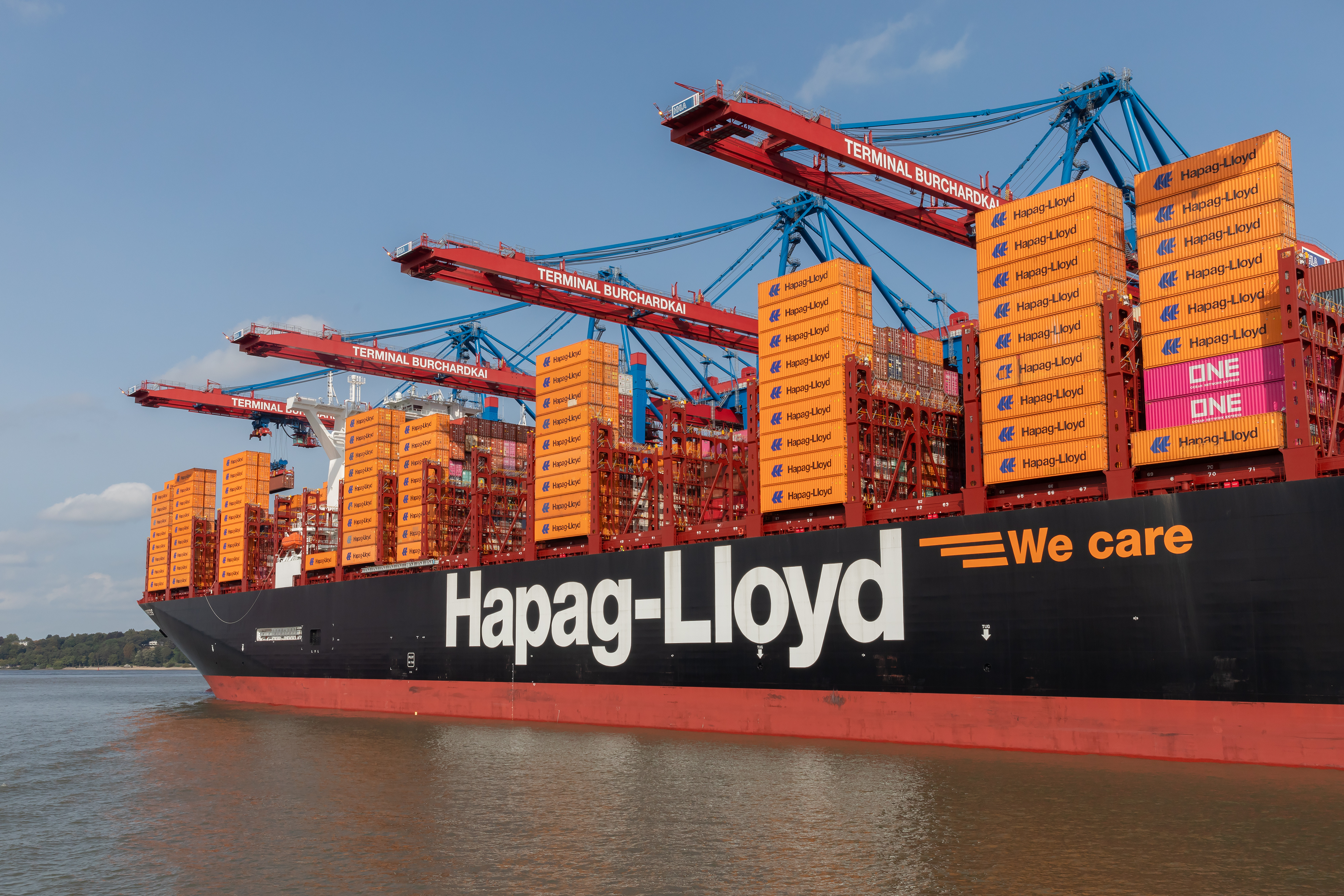
On Friday, 26 June, Hapag-Lloyd published a Middle East Emergency Surcharge (MES) for affected Gulf-bound cargo. The detail most shippers will miss is who it applies to: not new bookings, but affected cargo already in transit, at a transshipment hub, or inside the region awaiting alternative delivery.
That distinction matters because it removes the usual escape hatch. With most surcharges, you can see the announcement, recheck the quote, and decide whether to book. The MES lands on cargo you committed to weeks ago — shipments that are mid-transit, sitting at a transshipment hub, or already inside the affected region waiting on alternative delivery. There is no booking decision left to make. The charge is a cost you absorb on cargo already moving.
Who the MES applies to
Existing bookings, not new ones. Hapag-Lloyd’s advisory is explicit that the MES applies to existing bookings already in transit and affected by the disruption, and does not apply to new bookings unless separately advised. In practice that covers three situations: cargo currently on the water, cargo already discharged at transshipment hubs such as India, Pakistan, Salalah, or Khor Al Fakkan, and cargo already inside the affected region that needs alternative delivery arranged.
Seven Gulf destinations. The affected destinations are the United Arab Emirates, Saudi Arabia (excluding Jeddah), Kuwait, Qatar, Bahrain, Iraq, and Oman. Jeddah is carved out, and several of the published re-routing options move cargo through Jeddah before trucking it to its final Gulf destination.
This is an escalation, not a first move. When the Strait closed at the start of March, Hapag-Lloyd’s War Risk Surcharge already applied to cargo on the water but not yet discharged from the Gulf, alongside a $1,500-per-TEU standard-container rate. The MES extends that pattern into a full re-routing tariff. It is the fourth month of a disruption that carriers are increasingly treating as an extended operational problem rather than a short-lived interruption.
What it costs, by routing
The MES is not a single number. It is a menu of delivery options, priced by how far the cargo has to travel and by what mode once it diverts. The figures below are from Hapag-Lloyd’s advisory and reflect the published options for dry cargo; reefer, dangerous goods, and out-of-gauge cargo carry higher rates.
| Routing (final leg) | Haulage | 20′ dry | 40′ dry |
|---|---|---|---|
| India / Salalah → vessel → Jeddah / Ain Sokhna | Merchant | USD 1,200 | USD 2,300 |
| → Jeddah → truck → UAE | Carrier’s | USD 5,600 | USD 6,700 |
| → Jeddah → truck → Kuwait | Carrier’s | USD 6,100 | USD 7,200 |
| → Jeddah → truck → Qatar | Carrier’s | USD 5,750 | USD 6,850 |
| → Jeddah → truck → Bahrain | Carrier’s | USD 4,600 | USD 5,700 |
| → Fujairah / Khor Fakkan → truck → UAE points | Merchant | USD 2,200 | USD 3,100 |
| → Fujairah / Khor Fakkan → Jebel Ali → vessel → Upper Gulf | Merchant | USD 2,600 | USD 3,900 |
| Jebel Ali → vessel → Upper Gulf / UAE ports | Merchant | USD 300 | USD 600 |
| Jebel Ali → vessel → destination outside Gulf | Merchant / Carrier’s | USD 2,200 | USD 3,100 |
The spread is the story. A box already at Jebel Ali needing a short feeder hop carries USD 300 to 600. By comparison, trucking cargo from Jeddah to the UAE, Kuwait, Qatar, or Bahrain runs USD 4,600 to 7,200, depending on destination and container size. The cost is set less by where the cargo is going than by where it happened to be when the disruption caught it.
For context on magnitude: Trade Finance Global put Shanghai-to-Jebel Ali spot rates at over $8,000 per container, roughly quadruple their March level, and noted that the new emergency charges run more than ten times the $400-per-FEU disruption surcharge Maersk used during the 2023 Red Sea crisis. The MES is not a marginal add-on. On some lanes it is a material share of the all-in cost.
The charges that stack on top
The MES is rarely the only line item. Hapag-Lloyd’s advisory lists four additional charges that may apply depending on routing and the delivery option chosen:
- War Risk Surcharge — applies to most Middle East destinations, excluding Jeddah.
- Change of Destination Fee — applies if the original final destination is changed, which several re-routing options require.
- Storage Fees — for the period cargo sits at a stopover or transshipment port.
- Contingency Surcharge — applies to Jeddah-related routing where relevant.
For a single shipment that discharged at Khor Al Fakkan and now needs trucking onward, the invoice can carry the MES, a war risk surcharge, a change-of-destination fee, and storage for the days it waited — four separate lines, each tied to a different leg of a journey the cargo owner did not plan. Reconciling that invoice means knowing which charge maps to which operational event, at the container level, after the fact.
When a surcharge lands on cargo already in transit, the difference between a clean reconciliation and a dispute is whether you can tie each charge to a specific container’s actual movement. If your team is matching emergency surcharges to shipments by hand across a disrupted Gulf network, walk through how ops teams trace each charge to container-level events.

What to do this week
Identify your exposed boxes first. The MES applies to cargo already moving toward the seven affected destinations. Pull every Gulf-bound shipment currently on the water or sitting at a transshipment hub, and confirm with Hapag-Lloyd which delivery option applies to each. The option determines the cost, and on this tariff the gap between options is thousands of dollars per box.
Check whether you have a choice. The advisory frames the options as customer-selectable depending on cargo location and final destination. Where you can still influence the routing — choosing a Jebel Ali feeder over a Jeddah truck leg, for instance — the cost difference is large enough to be worth the conversation before the cargo is committed to a path.
Expect the invoice to be layered. Budget for the MES plus the stacked charges, not the MES alone. The war risk, change-of-destination, and storage lines are where the all-in number diverges from the headline surcharge, and they are easy to miss when only the MES is quoted up front.
This is a single-carrier announcement on a fast-moving disruption. Hapag-Lloyd’s advisory is the authoritative source for the current options and amounts on your specific lane — confirm against it before you commit cargo or accept an invoice, because the figures change with limited notice.
MES options, scope, affected destinations, and additional charges are from Hapag-Lloyd’s 26 June 2026 advisory, “Implementation of Middle East Emergency Surcharge (MES).” Spot-rate and magnitude context from Trade Finance Global, 26 June 2026. March War Risk Surcharge precedent from The National. Figures are as of 26 June 2026 and change with limited notice; always confirm the current amount, scope, and booking status on Hapag-Lloyd’s live advisory for your specific lane.
Further Reading
- Hapag-Lloyd — Implementation of Middle East Emergency Surcharge (MES)
- Trade Finance Global — Shipping lines impose new Gulf surcharges as Hormuz disruption enters fourth month
- The National — Strait of Hormuz escalation rattles global shipping with war levies and insurance cover cuts
Need help interpreting this disruption or your shipment?
For a quick question, chat with Tradlinx on WhatsApp. For a deeper discussion, book a time below.
Prefer email? Contact us directly at min.so@tradlinx.com (Americas), sondre.lyndon@tradlinx.com (Europe), or henry.jo@tradlinx.com (EMEA/Asia).


Leave a Reply