
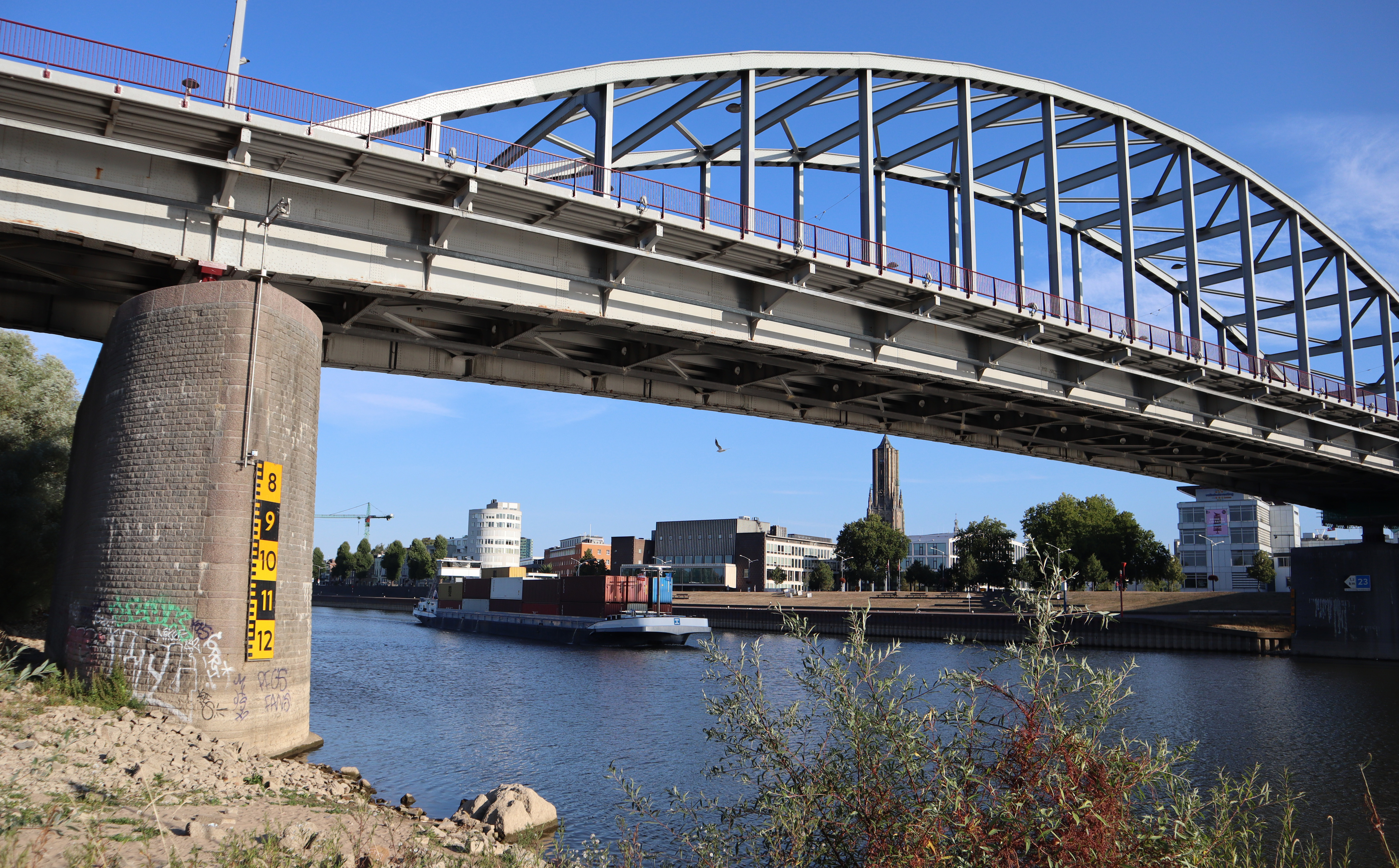
Two announced Dutch strike dates in September complicate inland planning, but only the 9 September rail walkout directly creates a need for alternatives to rail. Road and, where operationally feasible, barge may provide substitutes for affected containers. For Rhine hinterland cargo, however, barge cannot currently be treated as a dependable fallback.
The Kaub gauge is a key reference point for the rocky Middle Rhine, one of the most restrictive sections on routes between the North Sea ports and the German, French and Swiss hinterland. Its reading is measured against a fixed reference datum rather than representing the physical depth beneath a vessel, but it is used to estimate available channel depth and therefore the loading draft vessels can safely use.
Kaub read 23cm on 5 August 2026. At that level, Contargo had moved to individually agreed pricing, Maersk was in its lowest published surcharge tier and no longer offered a loading guarantee, Hapag-Lloyd’s published Kaub ladder had no applicable lower band, and CMA CGM’s advisory stated that no barge transport was possible below 24cm.
What the Gauge Has Actually Done
Contargo publishes daily readings for the four gauges governing its Rhine container services, taken at 05:00 CET from the German Electronic Waterways Information System. The overall trend since early July has been sharply downward, interrupted by several brief rebounds.
| Date, 2026 | Kaub | Cologne | Duisburg-Ruhrort | Emmerich |
|---|---|---|---|---|
| 1 July | 86 cm | 132 cm | 219 cm | 55 cm |
| 15 July | 42 cm | 90 cm | 177 cm | 24 cm |
| 21 July | 85 cm | 117 cm | 198 cm | 29 cm |
| 22 July | 77 cm | 122 cm | 201 cm | 39 cm |
| 27 July | 36 cm | 83 cm | 171 cm | 18 cm |
| 31 July | 25 cm | 71 cm | 155 cm | 5 cm |
| 4 August | 24 cm | 68 cm | 150 cm | -4 cm |
| 5 August | 23 cm | 70 cm | 154 cm | -4 cm |
The rebound from 42cm on 15 July to 85cm on 21 July is the reason a single reading is a poor basis for a booking decision. During that sequence, Kaub rose by as much as 20cm in one day before falling by as much as 14cm in one day as the recovery reversed.
The surcharge that ultimately applies is determined by the gauge reading on the barge’s departure date, rather than the date on which the booking was made. Export moves use departure from the inland terminal; import moves use departure from the seaport.
Published Tariffs Are Reaching Their Operational Limits
Maersk’s Rhine low water surcharge took effect on 15 July and applies to full containers only, keyed to the Kaub, Cologne and Duisburg-Ruhrort gauges. The Kaub ladder applies to terminals south of Koblenz.
| Kaub level | 20′ | 40′ | 45′ |
|---|---|---|---|
| Below 1.51 m | EUR 45 | EUR 55 | EUR 85 |
| Below 1.31 m | EUR 60 | EUR 80 | EUR 120 |
| Below 1.11 m | EUR 80 | EUR 95 | EUR 145 |
| Below 0.91 m | EUR 100 | EUR 150 | EUR 225 |
| Below 0.81 m | EUR 195 | EUR 250 | EUR 375 |
| Below 0.71 m | EUR 270 | EUR 330 | EUR 495 |
| Below 0.61 m | EUR 345 | EUR 455 | EUR 685 |
| Below 0.51 m | EUR 880 | EUR 1,055 | EUR 1,250 |
| Below 0.41 m | EUR 1,250 | EUR 1,490 | EUR 1,570 |
| Below 0.31 m | EUR 1,335 | EUR 1,560 | EUR 1,670 |
Two features of that ladder matter more than the individual amounts. The step from below 0.61m to below 0.51m more than doubles the 20′ charge, from EUR 345 to EUR 880, so the cost curve steepens sharply rather than rising in proportion to the fall in water.
Maersk’s ladder has not technically run out: its lowest published tier applies to any reading below 31cm. Every daily Kaub reading from 28 July through 5 August fell inside that tier. There is no additional published step if the water falls further, however, and Maersk separately warns that barge transport may become operationally infeasible.
Maersk also states that where Kaub falls below 81cm or Duisburg-Ruhrort below 181cm, a loading guarantee for cargo cannot be granted. Kaub has been below 81cm on every daily Contargo reading since 22 July.
Contargo moves outside its published tariff sooner. Its deepest quoted Kaub band is 90cm to 81cm at EUR 120 per 20′ and EUR 165 per 40′. At 80cm or below, pricing is agreed individually rather than taken from a published figure. The same applies at Cologne below 105cm, Duisburg-Ruhrort below 180cm and Emmerich at 30cm or below. All four gauges were in that territory on 5 August.
Hapag-Lloyd publishes Kaub bands down to 50cm to 41cm, priced at EUR 775 per 20′ and EUR 930 per 40′. Its advisory says transportation cannot be guaranteed if Kaub reaches or falls below 80cm. A reading of 23cm therefore sits below its published Kaub tariff bands and well inside its no-guarantee range.
CMA CGM publishes a further Kaub band from 40cm to 25cm at EUR 1,075 per 20′ and EUR 1,280 per 40′, followed by the statement that no barge is possible below 24cm. At the 23cm reading recorded on 5 August, the gauge was below that stated operating threshold.
The result is not one market-wide surcharge threshold. Depending on the operator, the same reading may place a shipment in a published lowest tier, move it to individual agreement, remove the loading guarantee or fall below a stated barge-operability threshold.
How Much a Barge Can Load at These Levels
Contargo has published an illustrative scale showing how loading capacity falls as the Kaub reading declines. Up to roughly 250cm to 260cm, the example container vessels can load to full capacity. At 135cm, a 135-metre motor vessel rated at 500 TEU can carry only about half its normal load, meaning two vessels are required to move the same tonnage. At 75cm it takes four vessels. A further fall of 20cm, to around 55cm, requires at least six.
Those figures are an illustration rather than a live, fleet-wide capacity formula. The actual load depends on the vessel, cargo weight, required under-keel clearance, route and the controlling shallow section of the voyage.
The 23cm reading sits well below the bottom of Contargo’s illustrative loading scale. Contargo’s general explanation says navigation does not automatically stop when water is low, but that it can become uneconomical and that acceptance of transport requests may depend on available capacity. Its current operational warning goes further: if forecasts materialise, it may temporarily suspend regular inland waterway services to the Upper Rhine, Middle Rhine and Rhine-Main regions, with containers for those destinations moving primarily by rail or truck.
Carrier-specific limits also matter. CMA CGM’s advisory states that no barge is possible below 24cm at Kaub, while Hapag-Lloyd and Maersk warn that transport or loading cannot be guaranteed at considerably higher levels. Low water therefore needs to be treated as both a capacity and service-availability problem, rather than only as a surcharge.
Hapag-Lloyd’s hinterland advisory adds the wider operational consequences customers may face from the combined effects of low water, congestion and infrastructure disruption. These include train cancellations, extended transit times and temporary limits on empty-container availability. Empty availability is particularly important for export planners because it can constrain bookings even where the affected barge movement concerns an import flow elsewhere in the network.
If your team is working out which September boxes can still make an inland connection by opening a terminal portal, a carrier site and an operator schedule for each one, walk through how ops teams hold container-level milestones across carriers in a single view.

Who May Carry the Additional Cost When a Box Is Rerouted
Contargo has stated that, in order to move containers as quickly as possible, it may increasingly route shipments through various transshipment and transport hubs. It says that any storage, Demurrage & Detention or other additional charges arising from that routing fall outside its responsibility. It also accepts no liability for delays or additional costs arising directly or indirectly from the low water situation and the operational measures it requires.
The practical effect is that a container may be moved through an intermediate hub it was never originally booked to touch, placing it under different carrier, terminal or depot free-time and storage conditions. The resulting cost does not necessarily begin the moment the container arrives. Charges ordinarily become payable only after the applicable free period expires.
Which clock applies depends on the carrier’s terms, the terminal or depot tariff, the transport contract and the point at which the container is waiting. Carrier demurrage or detention and terminal storage may also be separate charges rather than interchangeable labels for the same exposure.
That makes the container’s current location and last confirmed event more useful than the routing stated on the original booking. Once a box has been diverted, the operating team needs to identify the hub, its arrival time, the applicable free-time terms, the responsible contracting party and the revised last free day.
What This Changes About the September Dates
Our earlier coverage of the Rotterdam, Amsterdam and Zeeland port strike and the 9 September rail walkout noted that road and barge operations are not part of the announced 9 September action and may provide alternatives for containers otherwise scheduled to move by rail, subject to feasibility, equipment and capacity.
The capacity qualifier now matters more. For some Dutch domestic rail movements, road or barge may remain usable alternatives where the terminal pair, schedule, equipment and available capacity permit. For containers routed onward through the Rhine hinterland, the conditions recorded on 5 August mean barge cannot be treated as a dependable default contingency.
That does not establish which mode will be viable on 9 September. The Kaub record shows that levels can recover or fall sharply within days, and conditions measured more than a month before the strike cannot determine the operational position on the departure date. Operators should reassess gauge forecasts, carrier acceptance, barge schedules and road capacity close to each planned movement.
The two constraints also run on different clocks. The strike dates are currently announced for fixed dates and may still change through negotiation. Low water is weather-driven, has no announced end date and can alter both pricing and service availability from one departure to the next.
What to Check Before You Commit a September Inland Leg
- The gauge reading and forecast closest to the barge’s departure date. The applicable charge is based on the departure reading, not the level when the booking was made.
- Whether the carrier or operator is accepting the movement at all. A published surcharge does not guarantee that a barge space or loading guarantee remains available.
- The applicable surcharge or operating threshold for the specific carrier. At the same Kaub reading, one operator may apply a tariff while another moves to individual agreement or suspends barge acceptance.
- Whether the rate remains published or must be individually agreed. At 80cm or below at Kaub, Contargo prices by agreement rather than its standard tariff.
- The equipment-specific charge. The 45′ rate is not a simple multiple of the 20′ rate at any Maersk tier.
- For Upper Rhine, Middle Rhine and Rhine-Main destinations, whether the operator has moved the container to rail, road or an intermediate hub, and what that does to transit time, cut-offs and connections.
- Road capacity and pricing separately from barge availability, particularly around the 9 September rail action.
- Empty-equipment availability at the export origin, separately from the status of the import flow.
- Which containers may be routed through an intermediate transshipment hub, which carrier, terminal or depot terms apply there, and when the relevant free period begins.
- The revised last free day for each container and whether the applicable carrier or terminal tariff provides any relief for low-water disruption.
Need help interpreting this disruption or your shipment?
For a quick question, chat with Tradlinx on WhatsApp. For a deeper discussion, book a time below.
Prefer email? Contact us directly at min.so@tradlinx.com (Americas), sondre.lyndon@tradlinx.com (Europe), or henry.jo@tradlinx.com (EMEA/Asia).
Further Reading
- Low Water Surcharge Information for Container Transport, Contargo
- Rhine River Low Water Surcharge and Benelux Update on Low Water Conditions, Maersk
- Rhine River Low Water Surcharge, Hapag-Lloyd
- Rhine River Low Water Surcharge, CMA CGM Benelux
- North Europe: Rhine Low Water Is Affecting Hinterland Transport, Hapag-Lloyd
- Low Rhine Water Levels Hit Cargo Volumes at Rotterdam, WorldCargo News
- Haven Rotterdam ziet 10 procent minder lading op Rijnvaart door laagwater, Nieuwsblad Transport
Gauge readings are as published by Contargo from ELWIS at 05:00 CET, with 5 August 2026 the latest dated reading available at the time of writing. Maersk surcharge levels are from its Rhine low water surcharge notice effective 15 July 2026 and valid until further notice. Contargo, Hapag-Lloyd and CMA CGM thresholds are taken from their published low water conditions and surcharge pages. Carrier and operator advisories may cite readings that differ slightly from the Contargo 05:00 series because readings can be taken at different times of day; a single source has therefore been used for all figures in the gauge table. During the July sequence shown above, Kaub rose by as much as 20cm and fell by as much as 14cm in a single day. Confirm the current reading, operator acceptance, applicable surcharge and loading-guarantee status directly before booking or quoting an inland leg.



Leave a Reply