
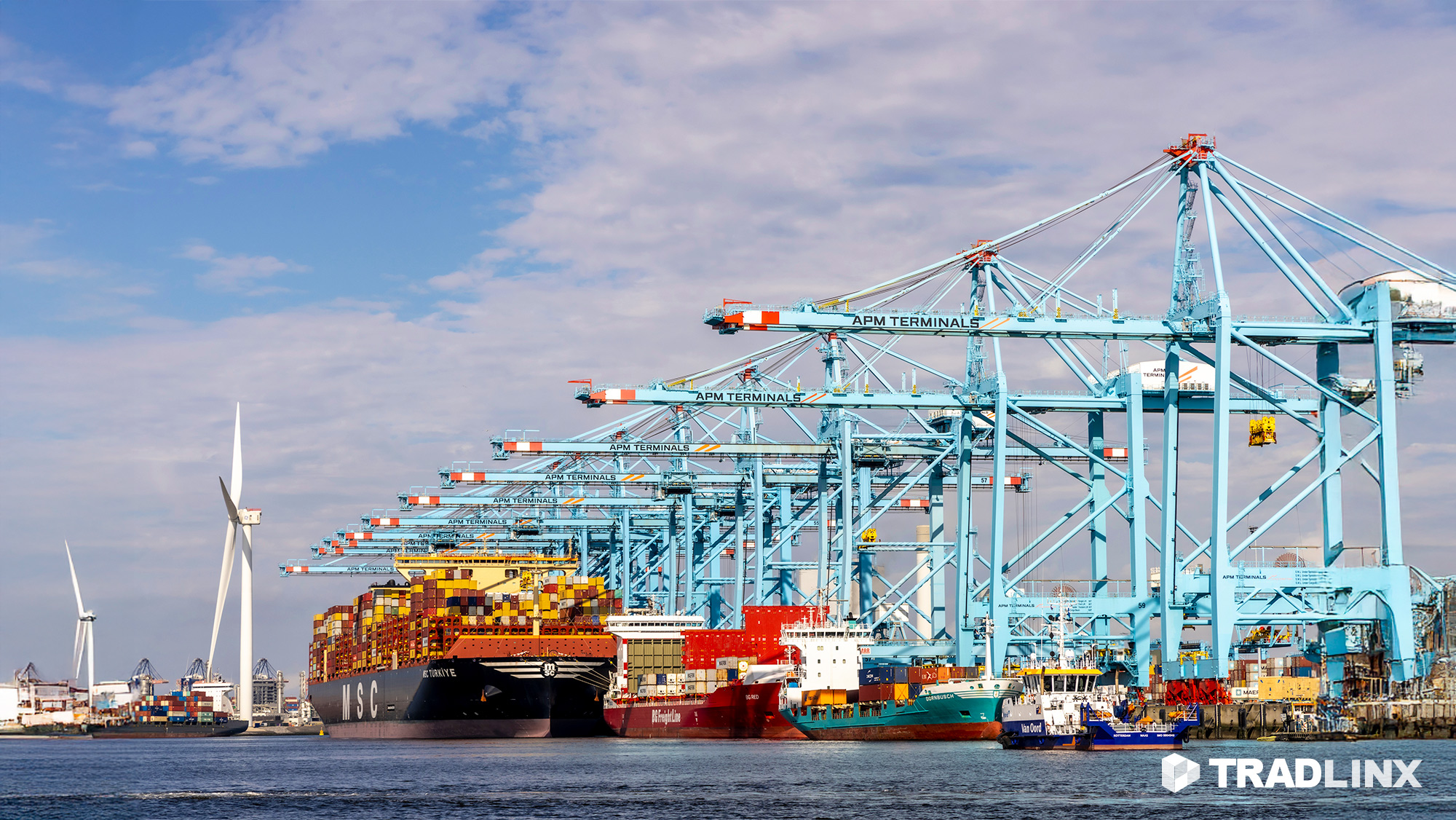
Dutch seaport workers stop handling ships at 11:15 local time on 4 September and resume at 19:00. Nearly eight hours, across Rotterdam, Amsterdam and Zeeland, called by FNV Havens as part of the union campaign against the government’s planned social security savings.
The exposure sits in the recovery period rather than in the nearly eight hours. A stoppage of that length is normally absorbed by the inland network working through the backlog over the following days. This time the recovery period has a second stoppage inside it: FNV and CNV have called a 24-hour national transport action for 9 September covering ProRail and DB Cargo, five days later, while the 4 September backlog is still draining.
The two dates as the advisories now describe them
When the action was announced at the start of August, the detail was limited to the dates and the ports. Operator advisories have landed since, and they are more specific than the announcement was.
| Date | Action | Window (local) | What stops |
|---|---|---|---|
| 4 Sep | FNV Havens seaport stoppage: Rotterdam, Amsterdam, Zeeland | 11:15 to 19:00 | Vessel handling. Loading, unloading, securing, towing and cargo checks |
| 4 Sep | Contargo Rotterdam terminal operations | About 10:30 to 20:00 | Truck handling, internal transport operations, loading and unloading of shuttle trains |
| 9 Sep | FNV and CNV national transport stoppage | 24 hours | NS, ProRail, urban and regional transport, DB Cargo |
The inland window is wider than the quay window
Contargo is telling customers to expect Rotterdam terminal activity restricted or suspended between roughly 10:30 and 20:00, which opens 45 minutes before the quay stops and closes an hour after it restarts. Inside that window the operator expects “no truck handling; no internal transport operations; no loading or unloading of shuttle trains; and restrictions regarding the provision and collection of trains.” It adds that some train rotations may have to be cancelled as a result.
That gap between the two windows matters more than its length suggests. A container discharged shortly before 11:15 does not move landside during the stoppage, so it joins the queue at the same moment as everything discharged after 19:00. The landside queue is already forming when the quay stops, and it does not begin to drain the moment handling resumes.
The modal fallback is interrupted twice
The standard response to a short port stoppage is to move the inland leg onto whichever mode is running. On these two dates that response has less room than usual.
- On 4 September, the road and shuttle-rail fallback is suspended at the terminal alongside the quay. Contargo’s advisory covers truck handling and shuttle train loading in the same window as the vessel stoppage, so shifting an import container onto a truck or a shuttle train that afternoon is not an available move at that terminal.
- On 9 September, rail comes off again. ProRail and DB Cargo are both named in the 24-hour action, and ProRail’s involvement reaches freight paths regardless of who is running the train. That falls inside the period when 4 September volume would ordinarily be clearing.
- Barge is the mode neither advisory addresses. Contargo’s warning does not mention barge services, and absence from an advisory is not confirmation that barge runs normally. Terminal barge windows depend on the same landside staffing. Check it with your operator.
Rerouting the ocean leg to a German port carries its own inland constraint, which we covered when six German ports reopened into Rhine low water. Fallback capacity on this corridor has not been free for some weeks.
Which containers are actually exposed
The population at risk is narrower than “everything routed through Rotterdam.” Four groups carry most of the exposure.
- Imports discharged between about 2 and 4 September. These are the units whose collection window overlaps the stoppage, and whose free time clock is already running while landside movement is unavailable.
- Imports with a rail onward leg scheduled 4 to 10 September. These face both actions. A missed shuttle rotation on 4 September may reschedule into a week that has a national rail stoppage in it.
- Exports with a cut-off falling on 3 or 4 September. Gate delivery on the day is constrained, and a missed cut-off rolls to the next sailing rather than the next day.
- Vessels berthing 4 or 5 September. Nearly eight hours of lost handling is recovered by working the ship longer or by trimming the call. The carrier makes that choice, and it usually surfaces in an advisory rather than in a schedule update.
Each of those tests needs a per-container answer: the discharge timestamp, the assigned onward mode, and the position in the landside queue. Those three fields sit in different systems. The week to assemble them is this one.
If your team is assembling that picture by opening terminal and carrier portals one at a time, it may be worth seeing how ops teams hold discharge status and onward-leg detail for every container in one place.
What changed since the announcement
Our earlier piece on what each of these dates targets, and the pre-4-September checklist, was written at announcement stage. The checklist there still holds and is not repeated here. Three things have firmed up since.
- The vessel-handling window is confirmed at 11:15 to 19:00. Kuehne+Nagel states that no ships will be handled between those times, which fixes the quay window that was previously indicative.
- An intermodal operator has published a wider window than the strike. Contargo’s 10:30 to 20:00 expectation, and its warning on train rotations, is the first landside-specific figure on record for this action.
- The 9 September scope now names freight. Early coverage framed it as a public transport stoppage. DB Cargo and ProRail are both inside the called scope, which puts freight paths in the affected set.
What is still open
- Carrier omission decisions. No carrier advisory omitting or reordering a Rotterdam call around 4 September had been published at the time of writing. That is the single item most likely to change a booking, and it usually appears in the last few days.
- Terminal-level participation. The action is called at sector level. Individual terminal operations can differ, and terminal advisories are the authority on their own gates.
- Barge continuity. Unaddressed in the advisories reviewed here.
- The 9 September hours. Announced as 24 hours without published start and end times.
- Escalation. The dispute concerns roughly €6.5 billion in planned social security savings, with the unions seeking withdrawal of cuts to unemployment and long-term disability benefits. A settlement before 4 September would remove both dates; no signal of one has been reported.
Key details at a glance
What time does the Rotterdam port strike start on 4 September?
Vessel handling stops at 11:15 local time and resumes at 19:00. Contargo expects Rotterdam terminal activity to be restricted or suspended over a wider window, roughly 10:30 to 20:00.
Which Dutch ports are affected?
Rotterdam, Amsterdam and Zeeland. The action is called by FNV Havens across Dutch seaports, and terminal-level participation can vary within that.
Does the 9 September strike affect rail freight?
Yes. The 24-hour national action covers NS, ProRail, urban and regional transport, and DB Cargo. ProRail’s participation reaches freight paths beyond DB Cargo’s own services.
Why are the workers striking?
The unions are opposing the government’s planned social security savings of around €6.5 billion over its four-year term, and are seeking the withdrawal of cuts to unemployment pay and long-term disability benefits.
Further Reading
- Dutch seaports brace for strike as Rotterdam operations face shutdown (WorldCargo News, 27 August 2026)
- Contargo warns of potential disruption to traffic from Rotterdam port strike (RailFreight.com, 27 August 2026)
- Dutch ports prepare for nationwide strike on 4 September (Kuehne+Nagel)
- Dutch unions call 24-hour public transport strike on September 9 (DutchNews.nl, July 2026)
Sourcing: the 4 September vessel-handling window of 11:15 to 19:00 local time is stated by Kuehne+Nagel and corroborated by WorldCargo News. The Rotterdam terminal window of approximately 10:30 to 20:00, the suspended landside operations and the train-rotation warning are Contargo’s own expectations as reported by RailFreight.com, and are the operator’s forecast rather than a terminal commitment. The 9 September scope covering NS, ProRail, urban and regional transport and DB Cargo is from DutchNews.nl; published start and end times for that action were not available. Terminal-level participation on 4 September may vary from the sector-level call. Confirm timings, gate availability, onward-leg status and cut-off times with your terminal, carrier and intermodal operator before acting on any figure here.



Leave a Reply